
30 Yard Dumpster in Green Bay, WI
Answer first: A 30 yard dumpster Green Bay fits large, light, bulky jobs — a whole-house cleanout, a large remodel, or demolition debris — about nine pickup truck loads. It is not a heavy-material box: a full 30-yard load of concrete, dirt, brick, or shingles will exceed its ton cap. Check size, material, and tons on the call before you book.
How big is a 30-yard dumpster, really?
A 30-yard dumpster holds about 30 cubic yards of debris, which works out to roughly nine pickup truck loads. That is the number to picture when you are standing in a full house or a gutted remodel and wondering whether one box will do it. The main Green Bay competitor publishes a 30-yard size of about 20 feet long by 7 feet 11 inches wide by 6 feet high. Dimensions vary by provider, so confirm the exact box on the call, especially if your driveway is short or narrow.
Height is the practical point people miss. A 30-yard box is tall. Loading it means lifting bulky furniture, cabinets, drywall, and lumber up and over a high side, or using a walk-in door if the provider’s box has one. Ask about that before delivery if anyone on the job has trouble lifting, or if the load includes large furniture that cannot easily be broken down. A box that is hard to load gets filled unevenly, and uneven loading wastes the space you paid for.
A 30-yard box also needs room to be delivered and picked up. The truck needs a straight approach, room to roll the box off, and overhead clearance. If your driveway is narrow, shared, or lined with low wires or branches, say so on the call. A smaller box that fits safely is better than a larger box that cannot be placed where you need it.
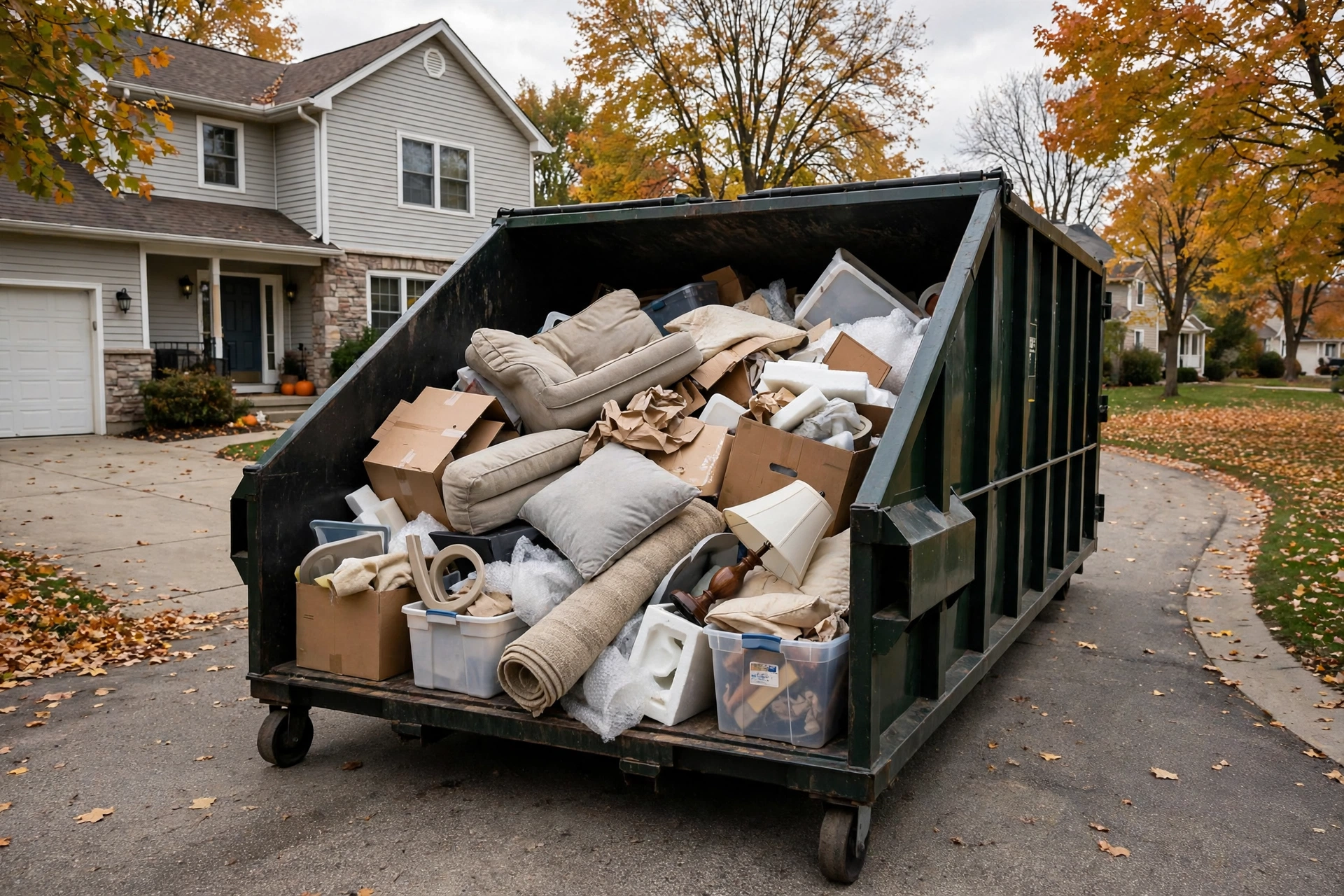
What jobs fit a 30-yard dumpster in Green Bay?
A 30-yard is the right starting point for large, light, bulky jobs. In Green Bay, that usually means a whole-house cleanout, an estate cleanout after a sale, a large remodel with several rooms of mixed debris, or a demolition job where the material is mostly wood, drywall, flooring, furniture, and household items. Green Bay’s housing stock explains why this size comes up so often: the median home was built in 1971 and about 48 percent of homes are pre-1970, so cleanouts and remodels here tend to produce a lot of bulky, mixed debris rather than a single neat material.
It is also the size people reach for when a 20-yard would need a swap halfway through. If you are clearing a full house, sorting as you go over several days, a single 30-yard with a clear fill plan can cost less in total than two 20-yard hauls, even though the headline price of the 30-yard is higher. That only holds if the load stays light and bulky. The moment the load turns heavy, the maths changes, and that is the next section.
A 30-yard is not the right box for a small job. If you are clearing one room, a garage, or a single bathroom, you will pay for space you do not use and you will struggle to load a tall box for a small pile. Start smaller in that case and size up only if the job grows.
The weight warning: volume is not the only limit
Every dumpster has two limits: volume in cubic yards and weight in tons. Household junk usually fills by volume first. Concrete, dirt, brick, asphalt, and roofing shingles hit the weight limit first, often when the box still looks half full. That distinction matters more on a 30-yard than on any smaller box, because the box is big enough to hold far more heavy material than its ton cap allows.
As a competitor-published market range, checked Oct 2026, confirm on the call: the main Green Bay competitor’s city-page range for a 30-yard is $515 to $695 with 2 to 3 tons included, and its online price is $515 for a 15-day base. Those are published market figures, not a quote from this site. The ton cap is the figure to focus on. Two to three tons sounds like a lot until you picture what heavy debris weighs. A 30-yard filled level with concrete, dirt, or shingles would weigh many times that cap, and the overage charge would follow. The main competitor’s pricing page lists $89 per ton over the cap, as a competitor-published market range, checked Oct 2026, confirm on the call. That is why providers typically limit how full a box can go for heavy material, or steer heavy jobs to a smaller box.
The rule to use on the call is simple. Tell the provider the material first, then the job size. If the load is mostly concrete, dirt, brick, or shingles, ask directly: is a 30-yard the right box at all, or should this be a smaller heavy-material box, filled only partway? If the load is mixed — say, a remodel with wood and drywall plus a small amount of tile or brick — ask how the mixed load affects the ton cap. Do not load a heavy 30-yard and hope the scale is forgiving. It will not be.
How much does a 30-yard dumpster cost in Green Bay?
There is no single Green Bay price for a 30-yard, because published prices bundle different days, tons, and materials. The honest way to compare is to line up size, price, days, tons, and overage together, and to treat every figure below as a competitor-published market range, checked Oct 2026, confirm on the call — never as a guaranteed price from this site.
| Source type | 30-yard published figure | Days | Tons included |
|---|---|---|---|
| Main Green Bay competitor, online price | $515 | 15-day base | Not shown with the headline price |
| Main Green Bay competitor, city-page range | $515–$695 | Varies by job | 2–3 tons |
| Hometown aggregator, Green Bay listing (not a hauler price) | $606–$660 | 7 days | 2 tons |
The spread itself is the lesson. A $515 rental for 15 days with a 2- to 3-ton cap is a different product from a $606 rental for 7 days with a 2-ton cap, even though both are called a 30-yard. Add the overage rate, the extra-day rate, and any trip fee, and the cheapest headline can become the most expensive total. The main competitor’s pricing page lists $21 per day past the rental period and a $150 trip fee, while its homepage says $10 per day over 15 days — an inconsistency in the competitor’s own published terms, cited honestly here. Ask the provider on the call which daily rate applies to your rental, and get the answer for your specific job, not the website headline.
Ask these five questions before you agree to anything: how many tons are included, what is the per-ton rate over the cap, how many days are included, what is the per-day rate after that, and is there a trip fee if the truck cannot deliver or pick up? If the provider cannot answer the tons question clearly, that is a reason to pause, not a detail to skip.
How long can you keep a 30-yard, and what about a swap?
Rental days vary by provider, and the published Green Bay figures show why you must confirm them. The main competitor publishes a 15-day base, while other Green Bay listings use 7 days. A whole-house cleanout or a large remodel rarely runs on a neat schedule, so days matter as much as size. If you need more time, ask about the extra-day rate before the rental period ends, not after it. The same applies to a swap: if the box fills early, ask before delivery what a swap costs and how quickly it can happen, so a full box does not stall the job.
For a large job, plan the loading order too. Put flat, bulky items at the bottom, break furniture down where you can, and keep the load level with the fill line. Nothing should stick above the sides. An overloaded box may not be picked up until it is levelled, and that means a return trip or extra handling. Tell the provider when you are done rather than assuming a pickup date, and keep the area around the box clear so the truck can reach it.
Where does a 30-yard go on your property?
A driveway placement generally does not need a permit in Green Bay. A street, sidewalk, or right-of-way placement generally does, and that is covered in full on the rules and permits page. For a 30-yard, the driveway question is also a fit question. Measure the driveway length and width, check for slopes, and look up for wires and branches. Providers typically need about 14 feet of overhead clearance, and a loaded 30-yard is heavy, so a soft lawn or a steep, icy slope is a poor spot unless the provider says otherwise.
Protect the driveway if the provider recommends it. Some haulers use boards under the wheels or supports at the front of the box, and that practice varies by provider, so ask what your provider does rather than assuming it. Clear vehicles from the spot before delivery, mark where you want the box, and tell the provider about gates, fences, or tight turns on the approach. A few minutes of measuring before the call saves a failed delivery on the day.
How many rooms will a 30-yard hold?
There is no fixed room count, because rooms in Green Bay’s older homes vary so much. As a rough guide, a 30-yard can hold the bulky debris from a whole-house cleanout or a multi-room remodel, including furniture, cabinets, drywall, flooring, and boxed household items, as long as the load stays light and bulky. A single room will not fill it. A house full of furniture plus a remodel’s debris will come closer. If you are between a 20-yard and a 30-yard, the deciding questions are weight and time: if the load is light and the job runs over days, the 30-yard usually wins; if the load is heavy, neither size solves the weight problem, and a smaller heavy-material box is the right conversation.
Can you put concrete, dirt, or shingles in a 30-yard?
You can put some heavy material in a dumpster, but a full 30-yard of it is the wrong use of this size, and the provider confirms the limit on the call. For a concrete driveway tear-out, a dirt excavation, or a full roof tear-off, providers typically use a smaller box and limit how full it goes, because the weight cap is reached long before the volume is. For a mixed remodel load with a small amount of tile, brick, or shingles mixed in with wood and drywall, ask how that mix affects the ton cap and the price. The worst outcome is loading first and asking later, because the overage bill arrives after the box is already full.
Internal links
- Green Bay dumpster rental guide
- What size dumpster fits your Green Bay job
- 20-yard dumpster for medium to large home jobs
- Dumpster rental rules and permits in Green Bay
- Where to dump construction debris in Green Bay
- Dumpster rental cost in Green Bay
Call now — get a real size and price for your job
Call: (920) 274-9992
Before you call, have these five facts ready:
- Size or job — 30-yard, or a whole-house cleanout, large remodel, or demolition job
- Material — light bulky debris, or mixed with concrete, dirt, brick, or shingles
- Address/ZIP — Green Bay or a core suburb, so the provider can confirm coverage
- Date you need it, and how many days you need it
- Placement — driveway, or street, alley, or lawn
On the call, ask about tons included, the per-ton overage rate, days included, the extra-day rate, and any trip fee. The provider confirms price, days, tons, delivery, and pickup for your specific job.
Lead-gen disclosure
This website is a lead-generation website. When you call the number on this page, you will be connected to an independent local dumpster provider through a call network. This website is not the hauler, owns no trucks or dumpsters, sets no price, and guarantees nothing — not size availability, delivery, pickup, days, tons, or a permit outcome. The provider on the call confirms price, days, tons, overage, delivery window, pickup process, and any permit need for your address. If a provider’s answer differs from a range on this page, the provider’s answer for your specific job controls.