
Kitchen and Bathroom Remodel Dumpster in Green Bay, WI
For a kitchen bathroom remodel dumpster Green Bay job, size by room count and material, not by the box alone. A kitchen produces bulky cabinets and flooring, a bathroom heavy tile and fixtures, and together they make a mixed load where weight matters as much as volume. Tell the provider the rooms, materials, and demolition days before you book.
The contractor trigger: “get a dumpster before we start”
Many remodel jobs in Green Bay start with the same sentence from a contractor: get a dumpster before we start. That sentence is not about convenience. It is about sequencing. Demolition produces debris faster than any other phase, and without a box on site, old cabinets, drywall, flooring, and fixtures pile up in the driveway, the garage, or the room next door, where they slow the crew and create a second handling job. A box delivered before demolition starts lets the crew tear out and load in one motion, room by room, and keeps the work area clear for the next trade.
Green Bay’s housing stock explains why this trigger is so common here. The median home was built in 1971, and about 48% of homes are pre-1970, so remodels are often updates to older kitchens and bathrooms: cabinets that have been in place for decades, flooring layered over older flooring, and bathrooms with tile and fixtures that are far heavier than they look. Tell the contractor and the provider the same facts, so the size, days, and placement are agreed once, not renegotiated after demolition has started. If the contractor has a preferred box size or a preferred placement spot, pass that on during the first call. The provider can then confirm whether that size fits your material and your driveway, or whether a different size or a swap plan fits better.
Size by room count, not by guesswork
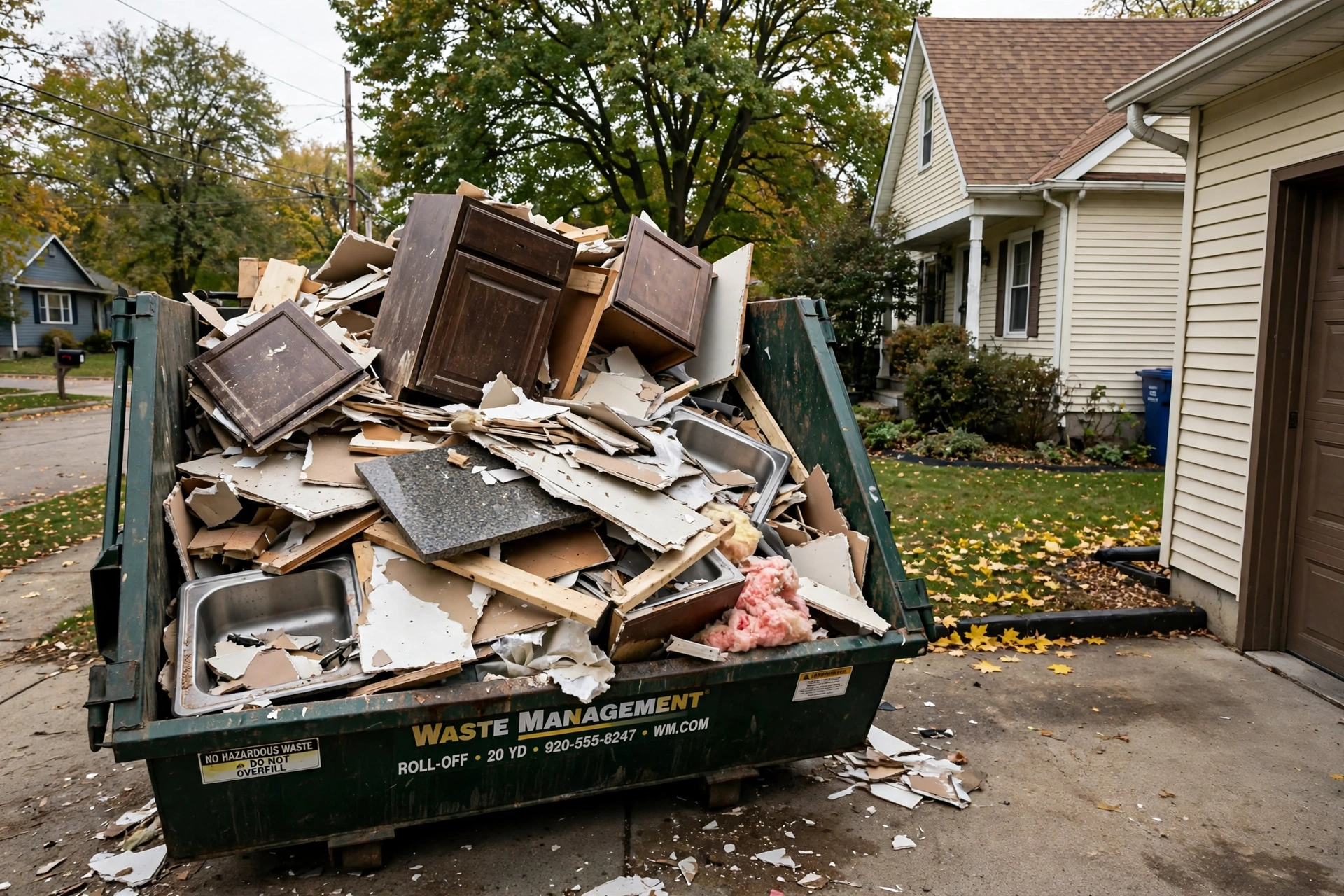
A remodel dumpster is sized by rooms and material together. A single bathroom remodel — a tub or shower, a vanity, a toilet, tile, and drywall — is a smaller job than a full kitchen remodel, but it can still be heavy, because tile and a cast-iron fixture weigh far more than the same volume of cabinets or drywall. A kitchen remodel — cabinets, countertops, flooring, drywall, and appliances in some cases — is bulky and mixed, and it usually needs a larger box than a single bathroom, even if the bathroom load is heavier per cubic yard. A kitchen plus a bathroom done together is not simply the sum of two small boxes. It is one mixed load, and the provider should size it as one job, with the heavy bathroom material counted against the same ton cap as the bulky kitchen material.
Use the Green Bay volume guides as a starting point only: a 10-yard box holds about 3 pickup loads, a 15-yard box about 4 to 5 loads, a 20-yard box about 6 loads, and a 30-yard box about 9 loads. Then adjust for weight and for days. A 15-yard box is a common starting point for a single-room remodel. A 20-yard box is a common starting point for a kitchen remodel or a kitchen-plus-bathroom job, for light to medium mixed debris. A 10-yard box fits a small bathroom refresh or a single-room tear-out where the material is light and the volume is genuinely small. A 30-yard box fits a large remodel or a multi-room demolition only for light, bulky debris — it is a poor choice for a load dominated by tile, concrete, or cast iron, because that load will exceed its ton cap before the box is full.
| Job | Starting size to discuss on the call | Material to flag | Weight warning |
|---|---|---|---|
| Small bathroom refresh | 10-yard | Tile, fixtures, drywall | Tile and cast iron are heavy — ask about the ton cap first |
| Single-room remodel | 15-yard | Cabinets, drywall, flooring | Mixed load — tell the provider everything going in |
| Kitchen remodel | 20-yard | Cabinets, countertops, flooring, drywall | Bulky but mixed — do not add heavy tile or concrete without asking |
| Kitchen plus bathroom | 20-yard, with a swap plan discussed | Mixed kitchen and bathroom debris | Heavy bathroom material counts against the same ton cap |
| Large multi-room remodel | 30-yard, light debris only | Wood, drywall, cabinets, flooring | Heavy material needs a smaller box or a separate plan — ask first |
If you are between two sizes for light material, size up. The price difference between sizes is usually smaller than the cost of a second delivery or a swap in the middle of demolition. For heavy material, do the opposite: call first and ask whether a smaller box, a higher ton cap, or a fill limit is the right answer.
Mixed debris: what actually goes in
A kitchen and bathroom remodel produces a mixed load, and the mix is the point. Expect wood from cabinets and trim, drywall, flooring of several kinds, countertop material, fixtures, and packaging from new material if the crew loads it as they go. Each material behaves differently in the box. Wood and drywall are bulky. Flooring varies — laminate and vinyl are light, tile is heavy. Cabinets are bulky until broken down, and breaking them down before loading saves volume and makes the load level, which matters for the fill line. Countertops vary by material, so name the material on the call rather than saying “countertops” and leaving the provider to guess.
Appliances need a separate question. Large appliances are restricted in many providers’ terms, especially appliances with refrigerant, and providers differ on appliances — so this page presents appliance acceptance as provider-dependent and directs the caller to ask on the call, rather than picking a side. If an old fridge, stove, or dishwasher is part of the remodel, name it on the first call. Do not load it and hope. The same rule applies to anything you are unsure about: hazardous materials, liquids, and Wisconsin-banned items cannot go in a rented dumpster. That includes hazardous chemicals, asbestos, paint and solvents in liquid form, motor oil and other automotive fluids, lead-acid batteries, tires, electronics, fluorescent lamps, medical waste, and flammable or explosive material. Wisconsin Department of Natural Resources landfill bans include electronics, major appliances, lead-acid batteries, waste oil and filters, tires, and paper and containers that belong in recycling, with yard waste banned since 1993 and tires since 1995. If demolition uncovers an unexpected material, stop and ask the provider before it goes in the box.
Weight risks: tile, cast iron, and concrete
The two weight risks most remodel callers miss are tile and cast iron. A bathroom floor and shower surround that look modest can produce a surprisingly heavy load once the tile, mortar, and backing come off together. A cast-iron tub is heavy on its own, and it concentrates that weight in one piece. This page does not invent a weight figure for either, because no verified per-item weight for your specific tub or tile is in this research, and a guessed number would be worse than an honest warning. The honest warning is this: tell the provider about tile and cast iron before delivery, and ask how they count against the ton cap. The provider may suggest a smaller box, a fill limit, a separate heavy-material plan, or a higher ton cap. Any of those answers is better than an overweight charge discovered after the box is picked up.
Concrete follows the same rule, and it is stricter. If a remodel includes a concrete or masonry tear-out — a hearth, a slab section, or a block wall — do not mix it casually into a general remodel box. Ask the provider whether it needs a smaller heavy-material box, a fill limit, or a separate load. A 20-yard box filled with concrete will exceed its ton cap long before it is full, and the provider may require it to be filled only partway for heavy material. Naming the concrete on the first call prevents that surprise entirely.
Days and swap planning
A remodel does not produce all its debris on one day. Demolition may take two or three days, then the crew pauses while new material is ordered, delivered, or installed, and then a second wave of debris — packaging, offcuts, old trim — appears later. Tell the provider how many days the whole job needs, not just the demolition days, and ask what happens if you need more days or a swap because the box fills early. A swap means the provider picks up the full box and drops an empty one. Ask whether there is a fee for a swap, how much notice the provider needs, and whether the swap resets the rental days or continues them.
The cost figures below are competitor-published market ranges, checked October 2026, confirm on the call. The main Green Bay competitor published online prices of 10-yard $480, 15-yard $490, 20-yard $495, and 30-yard $515 for a 15-day base, with city ranges of 10-yard $480 to $560 for 1 ton, 20-yard $495 to $670 for 1 to 2 tons, and 30-yard $515 to $695 for 2 to 3 tons, plus $89 per ton over the cap, $21 per day past the period on its pricing page ($10 per day on its homepage — ask which applies), and a $150 trip fee. Toss N Haul published 10-yard $300 for 2 tons, 15-yard $350 for 3 tons, and 20-yard $400 for 4 tons, for 7 days, with 14 days adding $50 and extra days at $10 per day. Compare any quote on size, days, tons, and overage together. A longer base period matters on a remodel, because a 15-day rental covers a paused job better than a 7-day rental that runs into extra-day charges while you wait for a trade.
Placement, fill line, and the curb boundary
A driveway placement generally does not need a permit. A street, sidewalk, or right-of-way placement generally does, from the municipality, and no Green Bay street permit fee or timeline is verified in this research, so this page does not state one — confirm it with the city or your village or town before you schedule a street placement. Tell the provider about overhead wires, a narrow driveway, or a steep approach, and mark the spot so the crew and the driver agree on it before demolition starts. Do not place a loaded box on a lawn without asking.
Respect the fill line. Remodel debris must not stick above the rim, and the load must be level enough to tarp and haul safely. A box loaded above the fill line may be refused for pickup or may trigger a trip fee. Breaking down cabinets and loading heavy material low in the box helps keep the load level and safe.
Finally, the curb is not a backup plan for remodel debris. In Green Bay, construction, remodeling, and demolition trash, appliances, electronics, and move-out debris are prohibited at the curb and at the East and West drop-offs at 1820 Mills St and 519 S Oneida St, and are charged to the property owner if left out. Construction debris is directed to the Brown County Transfer Station at 3734 W Mason St, whose current fee is unverified and is not stated here. That boundary is why a remodel dumpster exists: it is the legal route for the bulk of the job, and it should be booked before demolition, not after debris is already piled at the curb.
Questions remodel callers ask
What size dumpster do I need for a kitchen remodel?
A 20-yard box is a common starting point for a kitchen remodel with light to medium mixed debris, to be confirmed with the provider from your room count and material list. If the job includes heavy tile, concrete, or a cast-iron fixture, tell the provider first — the ton cap may change the size or the fill plan.
What size dumpster do I need for a bathroom remodel?
A 10-yard box can fit a small bathroom refresh, and a 15-yard box fits a fuller bathroom remodel, but tile and cast iron make weight the deciding factor. Name the tile and fixtures on the call and let the provider confirm the ton cap before you book.
Can I put a kitchen and a bathroom in one dumpster?
Usually yes, as one mixed load, sized as one job. Tell the provider both rooms and all materials, so the ton cap is set for the combined load. A kitchen-plus-bathroom job often needs a 20-yard box with a swap plan discussed in advance, rather than a box sized for one room alone.
How long should I keep the dumpster for a remodel?
For the full job, not just demolition — including pauses between trades and the second wave of packaging and offcuts. Ask the provider how many days are included, what extra days cost, and how a swap works if the box fills early. A longer rental agreed in advance usually costs less in stress and extra-day charges than a short rental that runs over.
Internal links
- Green Bay dumpster guide — the pillar guide for sizes, costs, permits, and disposal across Green Bay
- What size fits your job
- Green Bay cost ranges and how to compare them
- Permit and placement rules to check before delivery
- Where construction debris goes in Brown County
Call now — kitchen and bathroom remodel
Call (920) 274-9992
Before you call, have these five facts ready:
- Size or job — kitchen, bathroom, or both, and how many rooms are being remodelled
- Material — wood, drywall, flooring, cabinets, tile, fixtures, concrete, or mixed
- Address and ZIP — your Green Bay address, so the provider can confirm coverage
- Date and days — demolition start date, and how many days the full job needs
- Placement — driveway or street, and a description of the spot and access
Lead-gen disclosure
This website is a lead-generation website. When you call the number on this page, you will be connected to an independent local dumpster provider through a call network. This website is not the hauler, does not own dumpsters or trucks, does not set the provider’s price, and does not guarantee delivery, pickup, size availability, or a permit outcome. Your exact price, days, tons, overage rate, delivery window, and pickup process are confirmed by the provider on your call. If a provider’s answer differs from a range on this page, the provider’s answer for your specific job controls.