
Yard Waste and Storm Debris Dumpster in Green Bay, WI
For a yard waste dumpster Green Bay job, ask us before you load anything, because yard waste has been banned from Wisconsin landfills since 1993 and each provider and disposal site has its own rules. A clean yard load and a mixed storm load are not the same job, and yard waste is not accepted in every box.
Can I put yard waste in a dumpster in Green Bay?
The honest answer is: sometimes, and only after the provider confirms it. Wisconsin has banned yard waste from landfills since 1993. That ban does not mean yard waste disappears from the waste system. It means yard waste has to go through a route that is set up for it, such as composting or another approved disposal route, and a roll-off provider may or may not offer that route for your box.
Do not promise yourself, or a contractor, that yard waste will be accepted in every box. Some providers accept clean yard waste in a dedicated load. Others do not accept it in a mixed debris box at all. Others accept branches and brush but not soil, sod, or stumps, or accept them only with conditions. The only answer that counts for your job is the provider’s answer on the call, for your specific material, on your specific date.
If you load yard waste without asking, you risk a rejected pickup, a return trip fee, or an extra disposal charge, and a delay while the load is sorted or removed. A five-minute question before delivery avoids all three.
What is the difference between a clean yard load and a mixed load?
A clean yard load is yard material on its own: branches, brush, leaves, grass, and garden cleanout material, with no construction debris, household junk, or other waste mixed in. A mixed load is yard material loaded together with something else, such as fencing, decking, shingles, soil, concrete, furniture, or general cleanout junk.
That distinction matters for two reasons. First, a clean load can sometimes be routed differently from a mixed load, because it does not need to be sorted at the disposal site. Second, a mixed load is usually treated as general debris, and the yard material in it does not get the clean-load treatment just because it started in the garden. Mixing can also change the ton cap, the price, and whether the load is accepted at all, and those changes are provider-confirmed, not fixed by this page.
Keep the loads separate when you can. If a storm has left branches on top of a damaged fence, a shed, and a pile of household junk, do not throw it all in one box without asking. Sort as you go, or at least keep the clean branches in one pile and the mixed debris in another, so the provider can tell you whether one box, two boxes, or two separate routes make sense.
This page does not promise that a clean yard load is cheaper. It may be handled differently, but the price difference, if any, is provider-confirmed on the call. Ask directly: is a clean yard load priced differently from a mixed load, and what exactly counts as clean for your site?
What about storm debris after a Green Bay storm?
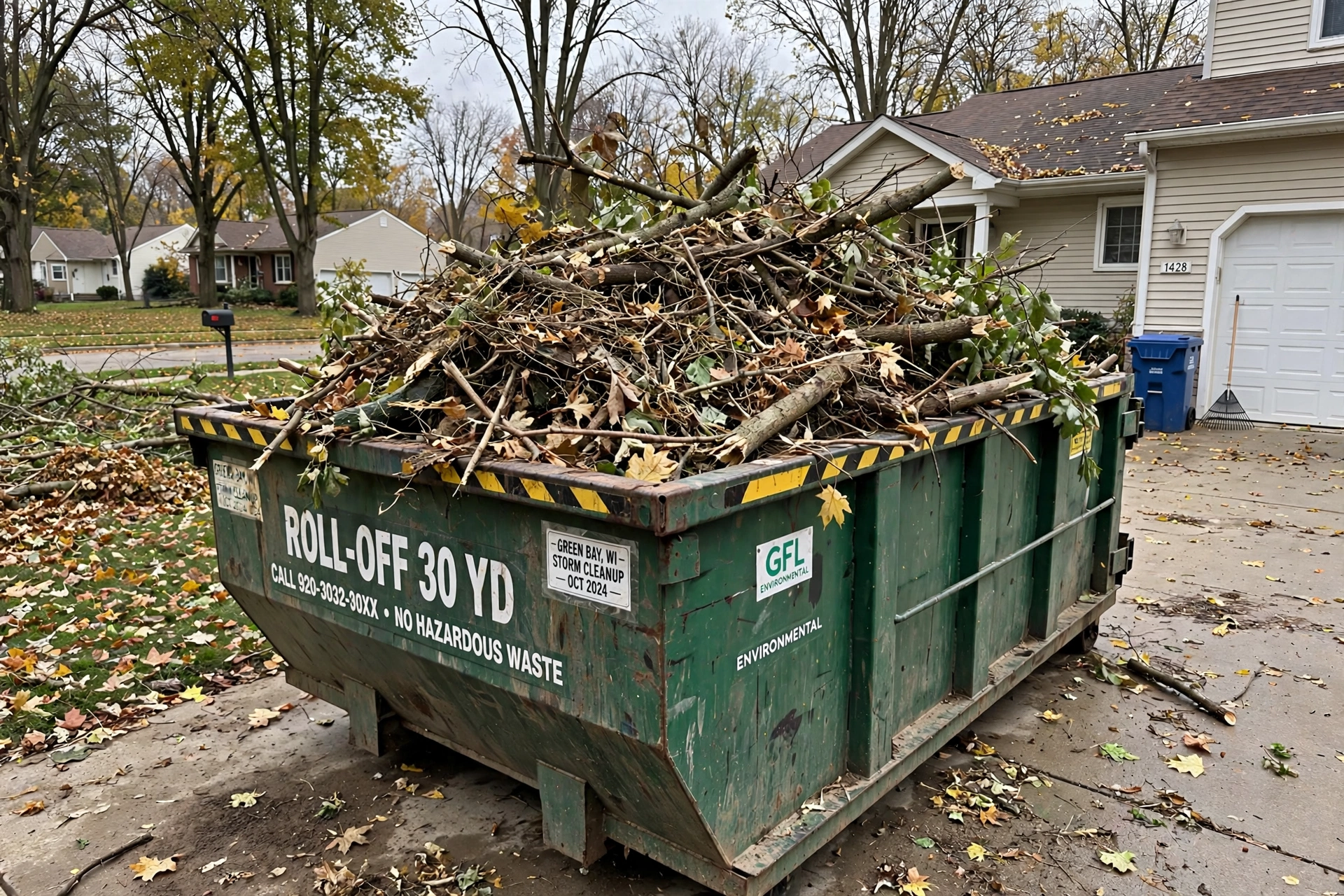
Storm debris is rarely just branches. After a wind or ice storm, a typical Green Bay pile can include branches and brush, but also fencing, roofing material, siding, a damaged shed or deck, soil, and household items that were stored outside. That is a mixed load, even if it looks like a yard job at first glance.
Start by sorting, not by loading. Put clean branches and brush to one side. Put fencing, timber, and building material to another side. Put anything hazardous, electronic, or banned to a third side, and do not load it at all. Then call with that sorted list. The provider can then tell you whether one box covers the job, whether the yard material needs its own route, and whether any of the material needs a separate disposal route entirely.
Green Bay weather makes this a regular job, not a rare one. The city averages about 55.6 inches of snow per year, with a January mean high around 25.5 degrees Fahrenheit and a July mean high around 81.0 degrees. Heavy snow, ice, and summer storms all bring down branches, and a spring thaw can leave a yard full of debris that has been sitting under snow for months. If a storm has damaged a roof or a structure, say so on the call, because roofing and building debris follow different rules from branches, and the provider needs to size the box for weight as well as volume.
What size dumpster works for a yard cleanup?
Size follows material and weight, not just how big the pile looks. Branches and brush are bulky but light when dry. Wet leaves, wet brush, soil, and sod are heavy, and a box that looks half full can already be near its ton cap. A small yard cleanup, such as a single garden bed, a hedge trim, and a few branches, may fit a small box. A full yard cleanup, a large tree removal, or a storm cleanup across a whole property usually needs a larger box, or more than one load.
Do not choose on cubic yards alone. Ask the provider for the ton cap for the size you are considering, and ask whether wet yard material changes that cap or the price. If you are between two sizes, ask whether sizing up is cheaper than paying for a second delivery or a swap in the middle of the job. The provider’s answer, for your material and address, is the one that counts.
This page does not publish a yard-waste-specific price, because no verified yard-waste-only price for Green Bay was in the brief. Market ranges for general Green Bay rentals in October 2026 ran from about $300 for a small 10-yard rental to about $695 for a large 30-yard rental, depending on size, days, tons, material, and provider. Those are competitor-published market ranges, checked October 2026, not a quote from this site and not a yard-waste price. Confirm the price for your yard load on the call.
What yard material should I not load without asking?
Do not load soil, sod, stumps, and large root balls without asking, even if they came from your own yard. They are heavy, they may be classed differently from branches and leaves, and some providers will not accept them in a yard box at all. The same applies to treated timber, painted fencing, railroad ties, and any material that may have been treated with chemicals. Treated wood is not the same as a clean branch, and loading it without asking can reclass the whole load.
Also do not load hazardous material, liquids, or Wisconsin-banned items in a yard box. Wisconsin landfill bans cover electronics, major appliances, lead-acid batteries, waste oil and filters, tires, and paper and containers that belong in recycling, and tires have been banned since 1995. If storm debris includes an old appliance, a battery, a tire, or electronics, set those items aside for their own disposal route and do not put them in the dumpster.
For the curb, the boundary is clear and worth repeating. Construction, remodeling, and demolition trash, appliances, electronics, and move-out debris are prohibited at the Green Bay curb and at the East and West municipal drop-offs at 1820 Mills Street and 519 South Oneida Street, and material left out there can be charged to the property owner. Construction debris is directed to the Brown County Transfer Station at 3734 West Mason Street. This page does not publish the transfer station’s current fee, because it is not verified.
How do Green Bay curbside weeks fit a yard job?
Green Bay’s free curbside options are for small household items within strict limits, not for a large yard or storm job. Bulk pickup weeks in 2026 were March 30 to April 3, rescheduled, and September 21 to 25, up to 2 cubic yards free, set out by 6 a.m. Overflow trash weeks were March 16 to 20, July 6 to 10, September 14 to 18, and December 28 to January 2, up to four 32-gallon bags.
If your yard waste fits those limits and is accepted at the curb under city rules, use the free option first. If it does not fit, if it is a large storm pile, or if it is mixed with construction or building debris, do not leave it at the curb and hope. That is the exact situation where a dumpster, or a provider-confirmed yard route, is the right call. When in doubt, call the city or the provider before you set anything out, because a rejected curb pile is still your problem to clear.
When should I call, and what should I have ready?
Call before you start cutting and piling, especially after a storm, when provider availability can tighten. The provider needs to confirm whether yard waste is accepted, whether your load counts as clean or mixed, the box size, the ton cap, the days included, and the delivery window. You also need time to clear the placement spot and to sort the pile, so the box is not sitting in the driveway while you are still deciding what goes in it.
Have the job in plain terms ready: yard cleanup, tree work, or storm debris; what the pile actually contains, not just “yard waste”; whether soil, stumps, fencing, or building material are in it; the address and ZIP; the date you need the box; how many days you need it; and whether it goes on the driveway or the street. A driveway placement generally does not need a permit in Green Bay, while a street, sidewalk, or right-of-way placement generally does, and the permit details must be confirmed with the municipality. This page does not publish a Green Bay street permit fee or timeline, because neither is verified.
Internal links
- Pillar guide: Dumpster rental in Green Bay, WI
- What size dumpster you need in Green Bay
- Dumpster rental costs in Green Bay
- The overweight and hidden-fees checklist
- Dumpster rules and permits in Green Bay
- Where construction debris goes in Green Bay
Call CTA
Call now: (920) 274-9992
Before you call, have these five facts ready:
- Size or job — yard cleanup, tree work, or storm debris, and roughly how large the pile is
- Material — clean branches and leaves only, or mixed with fencing, soil, stumps, or building debris
- Address/ZIP — Green Bay or a core suburb, with the exact placement spot
- Date/days — when you need the box, and how many days you need it
- Driveway vs street — driveway placement, or street, sidewalk, or right-of-way placement
Lead-gen disclosure
This website is a lead-generation website. When you call the number on this page, you will be connected to an independent local dumpster provider through a call network. This website is not the hauler, owns no trucks, sets no price, and guarantees nothing. The provider confirms price, days, tons, overage rate, delivery, pickup, yard-waste acceptance, and any permit requirement for your specific job on the call. If the provider’s answer differs from a range on this page, the provider’s answer controls.