
Roofing Dumpster in Green Bay, WI
For a roofing dumpster Green Bay job, ask about the ton cap before cubic yards. Old shingles are heavy, and a roofing load usually hits its weight limit long before the box looks full. Tell the provider the roof size, material, and layers coming off, and let the ton cap — not box size alone — decide the plan.
Why roofing is a weight job first
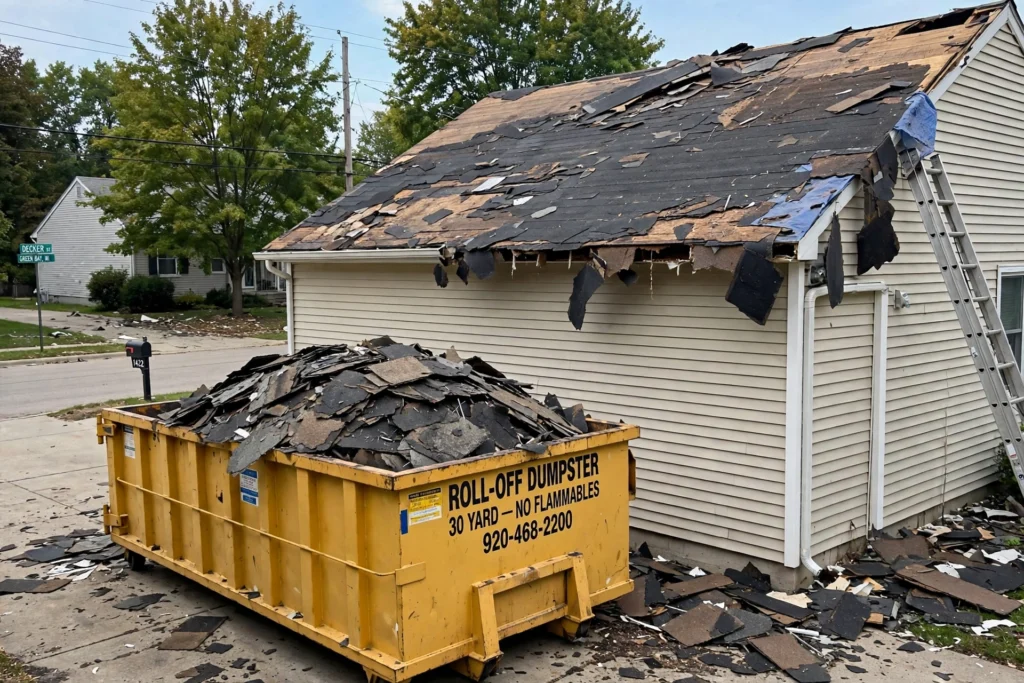
Most dumpster advice starts with volume: how many cubic yards, how many pickup loads. Roofing breaks that habit. A box of household junk usually fills by volume first — it looks full, and it is full. A box of shingles fills by weight first. It can look half full and already be at or over its ton cap, and that is the most common overweight surprise on a roofing job. The reason is simple: shingles are dense, and a tear-off adds up fast, layer by layer, square by square. If your roof has more than one layer coming off, say so on the call. Two layers is not the same load as one, and the provider needs that fact to set the ton cap and the fill limit correctly.
This page does not invent a squares-per-ton figure, and it does not quote a guaranteed roof price. No verified squares-per-ton conversion exists in this research, and any site that gives you one without naming its source and its shingle type is guessing. What you can do instead is give the provider the facts that let them size the job: approximate roof size in squares if your roofer has given it to you, the shingle material, the number of layers, and whether flashing, underlayment, and wood decking will also go in the box. Wood and metal flashing change the load from a clean shingle load to a mixed load, and mixed loads are capped and priced differently. Tell the provider the full load, not just the shingles.
What size roofing dumpster do you need?
Size follows the roof, the layers, and the ton cap together. As a starting guide only, the Green Bay guides use these volume figures: a 10-yard box holds about 3 pickup loads, a 15-yard box about 4 to 5 loads, and a 20-yard box about 6 loads. For roofing, treat those figures as an upper limit on volume, not a promise about weight. The provider may tell you to fill a box only to a certain level for shingles, even if there is visible room left. That is not the provider short-changing you. That is the ton cap doing its job, and it protects you from an overweight charge that would cost more than a second haul or a swap.
Competitor-published squares guidance, labelled as such, comes from Dump ‘N Go size cards, checked October 2026, confirm on the call: a 10-yard box at 12 by 7 by 4 feet was listed at about 35 roofing squares, a 15-yard box at 15 by 8 by 5 feet at about 40 squares, and a 20-yard box at 15 by 8 by 6 feet with no squares figure on that card. Those are a competitor’s published guide, not a rule from this site, and they do not replace the provider’s ton cap for your shingles. If your roofer’s square count sits near the top of a card’s figure, ask the provider whether you need the next size up, a second box, or a swap plan — especially if there are two layers. If your roofer has not given you a square count, say so. The provider can still size the job from the house footprint, the roof pitch, and the number of layers, but only if you give them those facts honestly instead of guessing a number.
| Size | Competitor-published squares guide (Dump ‘N Go, Oct 2026) | Typical roofing use | Weight warning |
|---|---|---|---|
| 10-yard | About 35 squares (12 by 7 by 4 feet) | Small roof, garage, or single-slope tear-off | Shingles hit the ton cap fast — ask about the cap and fill limit first |
| 15-yard | About 40 squares (15 by 8 by 5 feet) | Standard home roof tear-off | Two layers may need a swap or a second box — ask before loading |
| 20-yard | No squares figure on the Dump ‘N Go card (15 by 8 by 6 feet) | Large roof, multi-section job | Do not assume a 20-yard solves weight — the ton cap still controls the load |
Do not use a 30-yard box for a full shingle load unless the provider tells you to. A large box tempts a crew to keep loading, and a full 30-yard of shingles will exceed its ton cap long before it is full. For heavy material, a smaller box filled to its safe level, with a swap ready, is usually the cheaper total job.
What does a roofing dumpster cost?
This site does not set a price. The figures below are competitor-published market ranges, checked October 2026, confirm on the call. Compare them on size, days, tons, and overage together, never on headline price alone.
The main Green Bay competitor published, in October 2026, online prices of 10-yard $480, 15-yard $490, 20-yard $495, and 30-yard $515 for a 15-day base, with city ranges of 10-yard $480 to $560 for 1 ton, 20-yard $495 to $670 for 1 to 2 tons, and 30-yard $515 to $695 for 2 to 3 tons. Its pricing page listed $89 per ton over the cap, $21 per day past the period, and a $150 trip fee, while its homepage said $10 per day — ask which daily rate applies to your job, because the provider’s answer on your call controls. A second local provider, Toss N Haul, published 10-yard $300 for 2 tons, 15-yard $350 for 3 tons, and 20-yard $400 for 4 tons, for 7 days, with 14 days adding $50 and extra days at $10 per day. Those ton figures are that provider’s published figures, not a universal rule, and your provider may cap your roofing load differently.
That spread is the lesson. A $300 rental for 7 days with a low ton cap can cost more in total than a $495 rental for 15 days with a higher ton cap, once extra days and overage are added. For roofing, the total-cost question is not “what is the cheapest box” but “what is the cheapest box that holds my shingles without an overweight charge or a second haul.” Ask the provider to walk through that total with you: base price, days included, tons included, per-ton overage, extra-day rate, and any trip or swap fee. If any of those answers is unclear, ask again before you agree. A roofing crew works fast, and a pricing surprise discovered after the tear-off is already loaded is much harder to fix than one caught on the call.
The fill line is not optional
Every roll-off has a fill line, and roofing crews must respect it. Shingles must not stick above the rim, and the load must be level enough for the provider to tarp and haul it safely. A box loaded above the fill line may be refused for pickup, may need to be unloaded and reloaded, or may trigger a trip fee — the $150 trip fee published by the main Green Bay competitor is the published example of that kind of charge, confirm on the call whether it applies to your provider. Tell your roofer where the fill line is before the tear-off starts, not after the first day’s shingles are already in. A crew that knows the limit loads differently from a crew that discovers it at the end of the day. If the box fills early, a swap plan agreed in advance keeps the roof job moving. Ask before delivery how much notice a swap needs and whether it costs extra.
Timing a roofing dumpster in Green Bay
A roofing job is a timed job. The box should arrive before the tear-off starts, not during it, and it should be picked up promptly once the roof is done, because a full box sitting on a driveway blocks access and invites extra material from anyone passing by. Tell the provider the tear-off date, how many days the crew expects to need, and whether weather could push the job. Green Bay averages about 55.6 inches of snow per year, with a January mean high around 25.5 degrees Fahrenheit and a July mean high around 81.0 degrees Fahrenheit, so season matters: a winter or early-spring roof job faces snow, ice, and road weight limits — typically 6 tons single axle and 10 tons tandem, typically mid-March to mid-April in Wisconsin — that can affect heavy hauls and delivery timing. Ask on the call if your job falls in that window. In summer, the constraint is usually crew schedule and driveway access, not weather, but the same rule applies: give the provider the real dates, not the hoped-for dates.
Placement matters on a roofing job too. A driveway placement generally does not need a permit. A street, sidewalk, or right-of-way placement generally does, from the municipality. No Green Bay street permit fee or timeline is verified in this research, so this page does not state one — confirm it with the city or your village or town before you schedule a street placement. Tell the provider about overhead wires, a narrow driveway, or a steep approach, and mark the spot so the crew and the truck driver agree on it before the first shingle comes off.
What else goes in with the shingles?
A tear-off is rarely shingles alone. Underlayment, flashing, nails, and sometimes wood decking or trim go in the same box, and each changes the load. Metal flashing can sometimes be separated for recycling — ask the provider whether a separate metal route is cheaper or required, rather than assuming it goes in with the shingles. Wood decking adds volume and some weight, but it is not the same density as shingles, so a mixed load needs a mixed-load ton cap. Nails are a practical point, not a pricing point: after pickup, walk the driveway and the lawn edge for stray nails, because a tear-off scatters them. That walk is part of finishing the job properly, whether you or the roofing crew does it.
What cannot go in the box follows the same rules as any Green Bay rental. Hazardous materials, liquids, and Wisconsin-banned items are out: hazardous chemicals, asbestos, paint and solvents in liquid form, motor oil and other automotive fluids, lead-acid batteries, tires, electronics, fluorescent lamps, medical waste, and flammable or explosive material. Wisconsin Department of Natural Resources landfill bans include electronics, major appliances, lead-acid batteries, waste oil and filters, tires, and paper and containers that belong in recycling, with yard waste banned since 1993 and tires since 1995. If your roof job uncovers an unexpected material — old insulation, a suspect flashing material, or anything you are unsure about — do not load it and hope. Ask the provider before it goes in.
Questions roofing callers ask
Should I ask about tons or cubic yards first for shingles?
Tons first. Cubic yards tell you how much room the box has. Tons tell you how much shingle weight the provider will haul at the base price. For shingles, the ton answer decides the size, the fill limit, and whether you need a swap.
How many squares fit in a 10-yard or 15-yard dumpster?
As competitor-published guidance from Dump ‘N Go, checked October 2026, confirm on the call: about 35 squares for a 10-yard box and about 40 squares for a 15-yard box. Those figures do not replace your provider’s ton cap, and they do not account for layers, shingle type, or mixed material. Give the provider your square count and layer count and let them confirm the size.
What if the roof has two layers?
Tell the provider before delivery. Two layers roughly doubles the shingle weight for the same roof area, and it often means a smaller box filled to its safe level plus a swap, or a second box, rather than one larger box. Guessing one layer when there are two is how overweight charges happen.
Can the dumpster go on the street during a roofing job?
Generally only with a municipal permit where street or right-of-way placement requires one, and the provider confirms what applies to your address on the call. A driveway spot is simpler and usually needs no permit. If the driveway cannot fit the box, sort the permit question out before the tear-off date, not on it.
Internal links
- Green Bay dumpster guide — the pillar guide for sizes, costs, permits, and disposal across Green Bay
- What size fits your job
- Green Bay cost ranges and how to compare them
- Permit and placement rules to check before delivery
- Where construction debris goes in Brown County
Call now — roofing
Call (920) 274-9992
Before you call, have these five facts ready:
- Size or job — roofing tear-off, approximate squares, and number of layers
- Material — shingles, plus underlayment, flashing, wood, or other debris going in
- Address and ZIP — your Green Bay address, so the provider can confirm coverage
- Date and days — tear-off date, and how many days the crew needs the box
- Placement — driveway or street, and a description of the spot and access
Lead-gen disclosure
This website is a lead-generation website. When you call the number on this page, you will be connected to an independent local dumpster provider through a call network. This website is not the hauler, does not own dumpsters or trucks, does not set the provider’s price, and does not guarantee delivery, pickup, size availability, or a permit outcome. Your exact price, days, tons, overage rate, delivery window, and pickup process are confirmed by the provider on your call. If a provider’s answer differs from a range on this page, the provider’s answer for your specific job controls.