
Concrete Dumpster in Green Bay, WI
For a concrete dumpster Green Bay job, rent a smaller heavy-material box, keep the load clean, and fill only to the provider’s fill line, because concrete reaches its weight limit long before the box looks full. The provider confirms the size, ton cap, and clean-concrete rules on the call, before you break or load anything.
Why does concrete need a smaller dumpster in Green Bay?
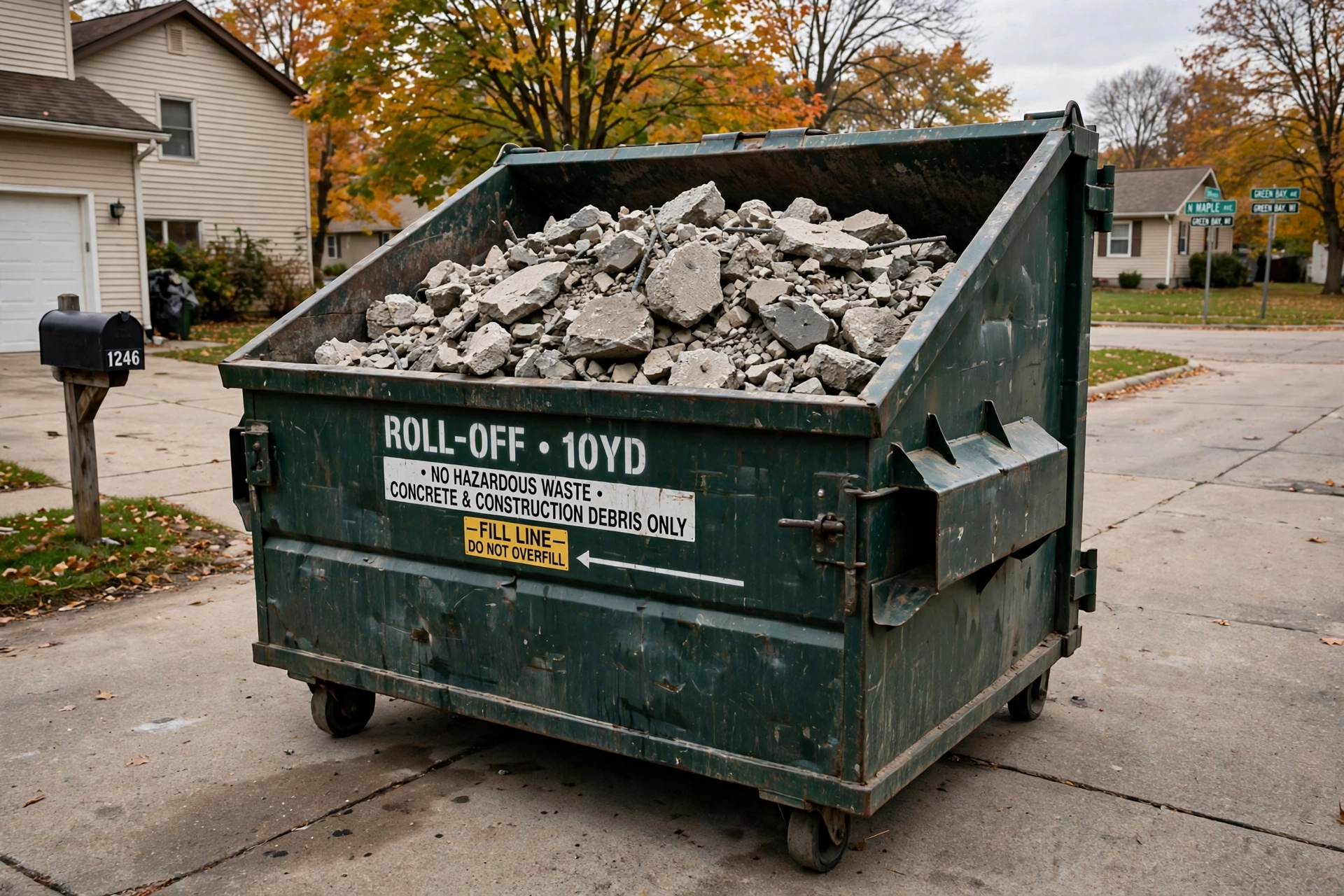
Concrete is heavy in a way that household junk is not. A box that would hold a room full of furniture with room to spare can be overweight with a single layer of broken driveway, patio, or sidewalk slabs. That is why providers in Green Bay typically use a smaller box for concrete, dirt, and asphalt: a smaller box controls weight, even though it holds less volume.
The mistake most people make is choosing by cubic yards alone. They picture how much concrete they have, pick a large box to be safe, and then find the load is overweight, cannot be hauled safely, or has to be partly unloaded. Choosing smaller is not choosing less service. It is choosing a box the truck can legally and safely lift once it is full.
Green Bay adds its own reason to get this right. With a median home build year of 1971 and about 48 percent of homes built before 1970, a lot of concrete work here is a driveway, patio, sidewalk, or basement floor in an older property, not a new-build slab. Access is often tight, the driveway may already be cracked, and the work is usually done in a short window while a contractor is on site. A box that is too large, too heavy, or placed in the wrong spot can slow that job down fast.
What does the ton cap mean for a concrete load?
A dumpster has two limits, and for concrete the weight limit matters first. The ton cap is the weight included in the rental price. Go over it, and the provider charges a per-ton overage rate. The exact cap and rate for your job are confirmed on the call, because they vary by provider, size, and material.
This matters because concrete looks deceptively light in pieces. A broken slab, a chunk of footing, or a pile of patio pavers adds up quickly, and wet concrete debris weighs more still. Do not judge the load by eye. Ask these questions before delivery, and write the answers down:
- What size box do you use for concrete, and what ton cap comes with it?
- How full may I fill it — level with the top, or only partway?
- What is the per-ton rate if I go over the cap?
- Can I ask for a scale ticket for my load?
- If the box fills early, what does a swap cost, and how fast can it happen?
If the provider gives you a fill line, treat it as a hard limit, not a guide. A box filled above the line may not be picked up until material is removed, and that removal is your delay, not the provider’s.
What counts as clean concrete, and why does mixed debris change the price?
Clean concrete is concrete loaded on its own, without other debris mixed in. Mixed debris is concrete loaded with dirt, brick, asphalt, wood, metal, household junk, or other material in the same box. The difference matters because clean material can often be handled and recycled through a different route than a mixed load, while a mixed load is usually treated as general construction debris.
This page does not publish a concrete price per ton, and it does not promise that clean concrete is cheaper in every case. Whether clean concrete is handled differently, and by how much, is provider-confirmed on the call. What you can do before the call is keep the loads separate if you can. Do not throw timber, shingles, soil, or household junk into a concrete box to save a trip, unless the provider has told you that mix is accepted and what it costs. One mixed load can turn a straightforward concrete job into a higher disposal charge and a rejected pickup.
Also ask about anything attached to the concrete before you load it. Rebar, wire mesh, large rocks, soil, and asphalt may change how the provider classes the load. Do not assume that because it came out of the same driveway, it belongs in the same box. Ask, load only what the provider has confirmed, and keep anything uncertain to one side until you have an answer.
What size should I ask about for concrete in Green Bay?
Start with a smaller box, and let the provider size up or down from the job, not from a guess about cubic yards. In Green Bay market ranges published by the main local competitor in October 2026, a 10-yard box was listed at $480 to $560 with 1 ton included, and a 12-yard box at $485 to $635 with 1 to 2 tons included. Those are competitor-published market ranges, checked October 2026, not a quote from this site, and they are not concrete-specific prices. Use them only to understand why a small box with a clear ton cap is the starting point for heavy material, then confirm the size, days, tons, and overage rate for your concrete job on the call.
For a small patio, sidewalk section, or single-car driveway strip, one small heavy-material box may be enough, with a second box or a swap if the job grows. For a full driveway tear-out, plan for more than one load from the start. It is cheaper, and far less disruptive, to plan a swap than to have an overweight box sitting in the driveway while work stops.
Do not use a large 20-yard or 30-yard box for a full concrete load. Those sizes are for light, bulky debris. A 20-yard or 30-yard box filled with concrete will exceed its ton cap long before it is full, and the provider may require it to be filled only partway in any case. If a contractor suggests a large box for concrete, ask the provider directly before delivery day.
How do I protect my driveway and get the placement right?
A loaded concrete box is heavy, and the truck that delivers and picks it up is heavier still. Tell the provider exactly where the box will go, how wide the driveway is, and whether there are overhead wires, a steep slope, or soft ground. A driveway placement generally does not need a permit in Green Bay, while a street, sidewalk, or right-of-way placement generally does, and the permit details must be confirmed with the municipality. This page does not publish a Green Bay street permit fee or timeline, because neither is verified.
One competitor practice is worth knowing about, labelled as such: Collins Dumpster Rentals describes driveway protection using boards under the wheels and support at the front of the box. That is a competitor’s published practice, not a promise from any provider reached through this site. Ask the provider on your call what driveway protection, if any, they provide, and whether they recommend plywood or boards under the box. If your driveway is already cracked, new, or decorative, say so on the call, before the truck arrives.
In spring, ask about timing as well. Wisconsin spring road weight limits are typically 6 tons for a single axle and 10 tons for a tandem axle, typically from mid-March to mid-April. A heavy concrete haul scheduled in that window may need different timing than the same haul in June. Ask on the call, rather than assuming the March schedule matches the summer schedule.
What cannot go in a concrete dumpster?
Do not load hazardous material, liquids, or Wisconsin-banned items in any dumpster, including a concrete box. That includes hazardous chemicals, asbestos, paint and solvents in liquid form, motor oil and other automotive fluids, lead-acid batteries, tires, electronics, fluorescent lamps, and medical waste. Wisconsin Department of Natural Resources landfill bans cover electronics, major appliances, lead-acid batteries, waste oil and filters, tires, and paper and containers that belong in recycling.
Construction, remodeling, and demolition trash is also prohibited at the Green Bay curb and at the East and West municipal drop-offs at 1820 Mills Street and 519 South Oneida Street, and material left out there can be charged to the property owner. Construction debris is directed to the Brown County Transfer Station at 3734 West Mason Street. This page does not publish the transfer station’s current fee, because it is not verified. If you are taking any material there yourself, call Brown County Recycling first to confirm the current fee and whether your material is accepted.
If you are unsure about one item, do not load it and hope. Set it aside and ask on the call. A prohibited item can mean a rejected pickup, a return trip fee, or an extra disposal charge, and for a concrete job it can also mean the whole load is reclassed as mixed debris.
When should I call, and what should I have ready?
Call before the concrete is broken, not after. The provider needs to confirm the box size, ton cap, fill line, days included, and delivery window, and you need time to clear the placement spot and, if the box will go on the street, to check the municipal permit position. A same-day request may be possible, but this site does not guarantee delivery speed, because it does not dispatch trucks.
Have the job in plain terms ready: driveway, patio, sidewalk, or floor; roughly how large the area is; whether the load will be clean concrete only or mixed; the address and ZIP; the date you need the box; how many days you need it; and whether it goes on the driveway or the street. Those five facts — size or job, material, address and ZIP, date and days, and driveway vs street — are what turn a vague quote into a usable answer.
Internal links
- Pillar guide: Dumpster rental in Green Bay, WI
- What size dumpster you need in Green Bay
- Dumpster rental costs in Green Bay
- The overweight and hidden-fees checklist
- Dumpster rules and permits in Green Bay
- Where construction debris goes in Green Bay
Call CTA
Call now: (920) 274-9992
Before you call, have these five facts ready:
- Size or job — concrete driveway, patio, sidewalk, or floor, and roughly how large
- Material — clean concrete only, or mixed with dirt, brick, asphalt, or other debris
- Address/ZIP — Green Bay or a core suburb, with the exact placement spot
- Date/days — when you need the box, and how many days you need it
- Driveway vs street — driveway placement, or street, sidewalk, or right-of-way placement
Lead-gen disclosure
This website is a lead-generation website. When you call the number on this page, you will be connected to an independent local dumpster provider through a call network. This website is not the hauler, owns no trucks, sets no price, and guarantees nothing. The provider confirms price, days, tons, overage rate, delivery, pickup, and any permit requirement for your specific job on the call. If the provider’s answer differs from a range on this page, the provider’s answer controls.