
RECYCLING
Dumpster Recycling in Green Bay, WI
Answer first: Some material can be recycled through a dumpster in Green Bay — clean concrete, clean metal, and separated paper and containers — but mixed loads are not automatically recycled, and electronics, appliances, batteries, and tires need separate routes under Wisconsin landfill bans. Tell the provider your exact material mix on the call, and ask whether a material-specific box is cheaper.
What can be recycled in a dumpster?
The honest answer starts with a distinction. A dumpster is a container, not a recycling plant. What gets recycled depends on what is in the box, whether it is separated, and where the provider takes it. Clean, separated material has the best chance of a recycling route. Mixed material, even if it contains recyclable items, is often handled as mixed debris, because sorting a mixed load at a facility costs time and money that a clean load does not.
Clean concrete is the clearest example. Concrete from a driveway, patio, or foundation tear-out, kept free of wood, drywall, trash, and other debris, is often handled as a recyclable or reusable aggregate rather than as landfill waste. That is why providers often use a smaller box for concrete and limit how full it goes — the weight cap, not the volume, is the limit, and a clean load keeps the disposal route simple. The same logic applies to clean metal. Scrap metal, pipes, fixtures, and clean metal debris have a recycling value and a separate handling route, which is why some Green Bay providers list scrap metal as its own job type. If your load is mostly clean concrete or mostly clean metal, say so first on the call, because a material-specific box may be priced differently from a mixed box, and it may be cheaper in total.
Paper and containers are a different case. Wisconsin landfill bans include paper and containers that belong in recycling, which means ordinary household paper, cardboard, and containers should go through the normal recycling route, not into a mixed dumpster load as a matter of course. In a cleanout, that means separating cardboard, paper, and containers where you can, and using the City’s recycling collection for them, rather than treating a dumpster as a substitute for recycling. A dumpster load that is mostly cardboard and paper is usually a sign the job needed sorting first, not a bigger box.
What needs a separate route, not a dumpster?
Wisconsin Department of Natural Resources landfill bans set the boundary for several materials: electronics, major appliances, lead-acid batteries, waste oil and filters, tires, and paper and containers that belong in recycling. Yard waste has been banned from Wisconsin landfills since 1993, and tires since 1995. Those bans do not mean those materials disappear. They mean they have separate routes, and the provider and the disposal site have rules for them. Ask before you load any of them.
Electronics are the most common surprise in a cleanout. Computers, monitors, printers, phones, and similar items are on the main Green Bay competitor’s restricted list, and they are covered by the Wisconsin electronics ban. They need an electronics recycling route, not a mixed dumpster load. The same applies to fluorescent lamps, which appear on the same restricted list. Lead-acid batteries, waste oil and filters, and tires each have their own handling rules and their own disposal routes, and none of them should be loaded into a mixed dumpster on a guess.
Yard waste needs careful wording. The 1993 landfill ban means yard waste cannot simply go to landfill, but that does not mean yard waste can never go in a dumpster. It means the provider and the disposal site have rules for it, and you must ask before you load it. Some providers handle yard waste in a dedicated load or route it to a composting or processing site. Others do not accept it mixed with household debris. If your job is mostly branches, leaves, grass, or storm debris, name that material on the call and ask for the yard-waste route, rather than assuming a mixed box covers it. Storm debris after a Green Bay storm is a common version of this question, and the answer is still provider-specific.
The appliance question, stated as provider-dependent
Appliances sit at the intersection of the landfill ban and provider practice, and Green Bay providers do not agree on them. Toss N Haul’s published position allows non-freon appliances, while the main Green Bay competitor bans washers, dryers, and fridges in its restricted list. This page does not pick a side, because no single verified Green Bay rule resolves the conflict. If your load includes a washer, dryer, fridge, freezer, or stove, name the exact appliance on the call, ask whether that provider accepts it, whether refrigerant changes the answer, and whether there is a separate route or charge. An appliance with refrigerant is a different item from a non-freon appliance, and the provider’s answer may depend on that distinction.
The same ask-first rule applies to any item that could be hazardous: paint in liquid form, solvents, chemicals, asbestos, medical waste, and anything flammable or explosive. Those items are not recycling, and they are not mixed debris either. They need a specific disposal route, and loading them into a dumpster creates a rejected pickup or an extra charge at best. Leave them out and ask.
Is a mixed load cheaper, or is separation cheaper?
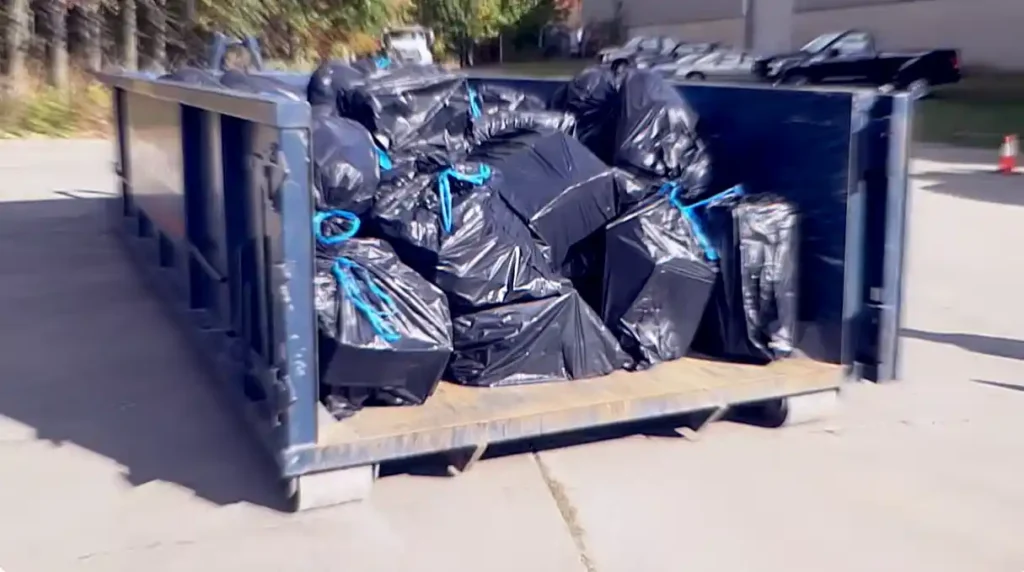
Mixed loads are convenient, and for a remodel or cleanout with truly mixed debris — wood, drywall, flooring, furniture, and household items together — a mixed box is often the only practical option. Convenience has a cost, though. A mixed load is usually priced as mixed debris, with a ton cap and an overage rate that apply to the whole load, even if part of it could have been recycled separately. A clean load, by contrast, can sometimes be priced differently, because the disposal site handles it differently.
The comparison to make on the call is total cost, not headline price. Ask three questions. First, is my load mostly one material, and would a material-specific box be cheaper? Second, if I separate clean concrete, clean metal, or cardboard before loading, does the mixed load’s price or ton cap change? Third, what is the per-ton overage rate for the mixed load, and how does my material mix affect the risk of exceeding it? For a load that is mostly concrete or mostly metal, separation usually wins. For a load that is genuinely mixed household and remodel debris, a single mixed box usually wins, because the time and handling cost of separating every item outweighs the saving. The provider can give you that answer for your specific mix, and that answer is worth more than any general rule on this page.
What this page does not claim about Green Bay recycling law
No ordinance citation was found for a claim that it is against Green Bay law not to recycle, and this page does not make that claim. Wisconsin’s landfill bans are state-level disposal bans, not a Green Bay recycling mandate stated here, and the City’s curbside rules are described as they are: construction, remodeling, and demolition trash, appliances, electronics, and move-out debris are prohibited at the curb and at the East and West municipal drop-offs (1820 Mills St and 519 S Oneida St), and material left out in violation can be charged to the property owner. That is a specific, verified boundary, and it is more useful than a broad legal claim without a citation. If a future source verifies a specific Green Bay recycling ordinance, it can be added with its citation. Until then, this page states the bans, the curb rules, and the provider rules, and nothing more.
How to sort a Green Bay load before the dumpster arrives
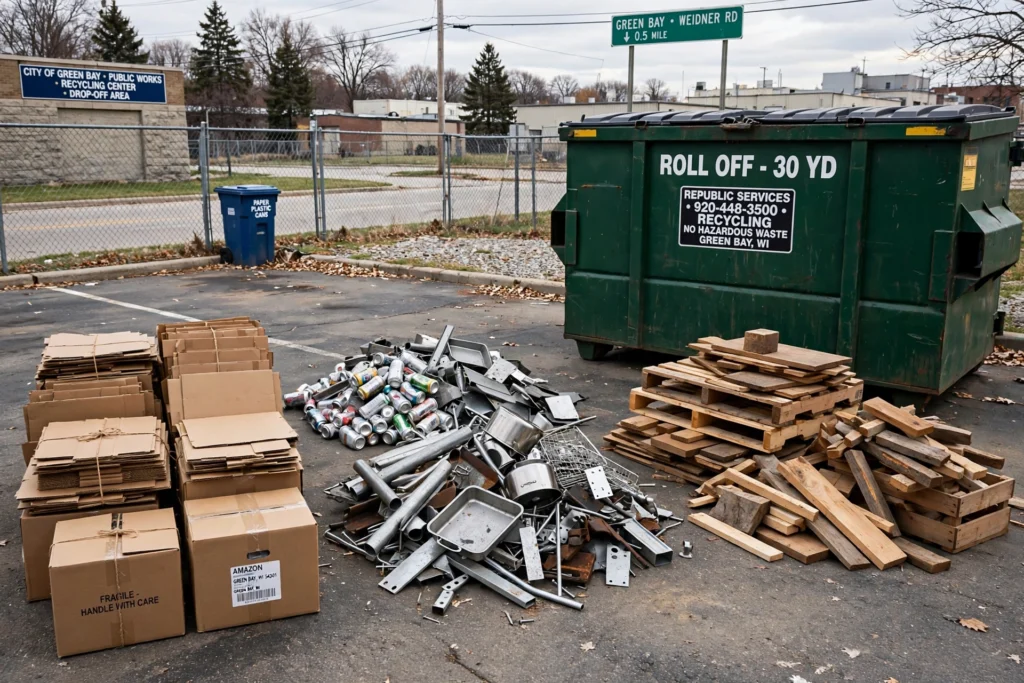
Sorting does not need to be perfect to be useful. It needs to separate the items that change the route or the price. Put clean concrete in one pile and keep wood, trash, and drywall out of it. Put clean metal in a second pile. Put cardboard, paper, and containers aside for the normal recycling collection. Put electronics, batteries, tires, paint, chemicals, and appliances in a separate “ask first” pile, and do not load any of them until the provider has answered for each item. Put yard waste in its own pile and ask for its route. What is left — mixed household and remodel debris — is the dumpster load, and its size and weight are now easier to estimate honestly. That five-pile sort takes an hour on a cleanout and can save a rejected pickup, an overage charge, or a second haul.
For a contractor job, the same sort applies at a larger scale. A roofing crew, a remodel crew, or a demolition crew that keeps clean material separate from mixed debris gives the provider a cleaner load to price and a simpler disposal route. Tell the provider the crew’s sorting plan on the call, because it can affect the box choice and the ton cap discussion. A crew that mixes everything into one box by default should be asked, before work starts, whether separation is practical for that job.
Internal links
- Green Bay dumpster rental guide
- Dumpster rental rules and permits in Green Bay
- Where construction debris goes in Green Bay
- How much a dumpster costs in Green Bay
- What size dumpster fits your Green Bay job
Call now — get a real size and price for your job
Call: (920) 274-9992
Before you call, have these five facts ready:
- Size or job — or the job, so the provider can size the box
- Material — clean concrete, clean metal, yard waste, paper and containers, electronics, appliances, batteries, or tires, named exactly
- Address/ZIP — Green Bay or a core suburb, so the provider can confirm coverage
- Date you need it, and how many days you need it
- Placement — driveway, or street, alley, or lawn
On the call, ask whether a material-specific box would be cheaper, whether each banned or questionable item is accepted, and what the ton cap and overage rate are. The provider confirms price, days, tons, delivery, and pickup for your specific job.
Lead-gen disclosure
This website is a lead-generation website. When you call the number on this page, you will be connected to an independent local dumpster provider through a call network. This website is not the hauler, owns no trucks or dumpsters, sets no price, and guarantees nothing — not size availability, delivery, pickup, days, tons, or a permit outcome. The provider on the call confirms price, days, tons, overage, delivery window, pickup process, and any permit need for your address. If a provider’s answer differs from a range on this page, the provider’s answer for your specific job controls.