
RULES & PERMITS
Dumpster Rental Rules and Permits in Green Bay, WI
Answer first: In Green Bay, a dumpster on your driveway generally needs no permit, while a dumpster on a street, sidewalk, or other public right-of-way generally needs a municipal permit and barricades. The permit is normally your responsibility unless the provider says otherwise, and the provider may need a copy before delivery. Confirm the rule for your address before you book.
Do I need a permit for a dumpster in Green Bay?
The short answer depends on one thing: where the box sits. If the dumpster sits fully on your private driveway, you generally do not need a permit in Green Bay. If any part of it sits on a street, sidewalk, alley, or other public right-of-way, you generally do need a permit from the municipality, and you may need barricades around it. That driveway-versus-street line is the rule most Green Bay guides get right in principle and then spoil by adding a fee or a timeline they have not verified. This page does not do that.
The permit, where one is required, is normally the customer’s responsibility unless the provider tells you otherwise on the call. That matters because it changes the order of your planning. Do not book a street delivery and then look into the permit. Ask the provider on the call whether they need a copy of the permit before delivery, and check with the municipality before you fix the delivery date. If the provider says they will handle the permit, get that in clear words on the call, including what they need from you and when.
Green Bay is not the only municipality in this market. The core service area also includes De Pere, Howard, Ashwaubenon, Bellevue, Allouez, and Suamico, and each city, village, or town can have its own process. A rule that applies on a Green Bay street does not automatically apply on a De Pere or Ashwaubenon street. Always confirm with the municipality for the delivery address, not with a general guide, and not with a neighbouring town’s rules.
What this page does not claim: fee and timeline
The street permit fee and timeline for a dumpster in Green Bay are not verified, and this page deliberately states no fee and no timeline. A general fee line in a city fee schedule has not been proven to be dumpster-specific, and a timeline found in vendor material has not been verified either. Publishing either number as fact would be worse than publishing neither, because a wrong permit number can mean a missed delivery, a fine, or a box sitting on the street without permission.
What you should do instead is direct and takes one call. Contact City of Green Bay Public Works, or your village or town office for a suburb address, and ask three questions: do I need a permit for a dumpster at this address and placement, what does it cost, and how long does it take? Then tell the provider the answer on your rental call, so the delivery date is set around the permit, not the other way round. If the municipality gives you a permit document, keep a copy ready, because the provider may need it before the truck leaves.
City of Green Bay 2026 Fee Schedule (Code 34-5, Streets, Sidewalks, and Other Public Places) lists an excavation/obstruction permit fee (base fee) of $75.00. That schedule does not state a dumpster-only fee or a processing timeline, so confirm with City Public Works whether a dumpster-only street obstruction is charged at the base fee only, and how long approval takes, before delivery.
Driveway placement: the usual case, done properly
Most Green Bay rentals go on a driveway, and that is the simplest placement. Clear vehicles from the spot before delivery, mark exactly where you want the box, and make sure the truck has a straight approach with room to roll the box off. Providers typically need about 14 feet of overhead clearance, so look up for wires, branches, and roof overhangs before the truck arrives, not while it is backing in.
Protect the surface if the provider recommends it. Some haulers put boards or plywood under the wheels, or supports at the front of the box, and that practice varies by provider. Ask what your provider does and whether they recommend boards for your driveway type. A loaded dumpster is heavy, and a driveway that is cracked, newly poured, or soft from rain is more at risk than a sound, older slab. If you are unsure about the driveway’s condition, say so on the call rather than discovering a crack after pickup.
Tell the provider about anything that affects the approach: a shared driveway, a steep slope, a narrow width, a gate, or a fence that limits the turn. A 10-yard box fits more driveways than a 20-yard or 30-yard box, so driveway fit can be a reason to choose a smaller box or a swap plan, even if a larger box would hold more.
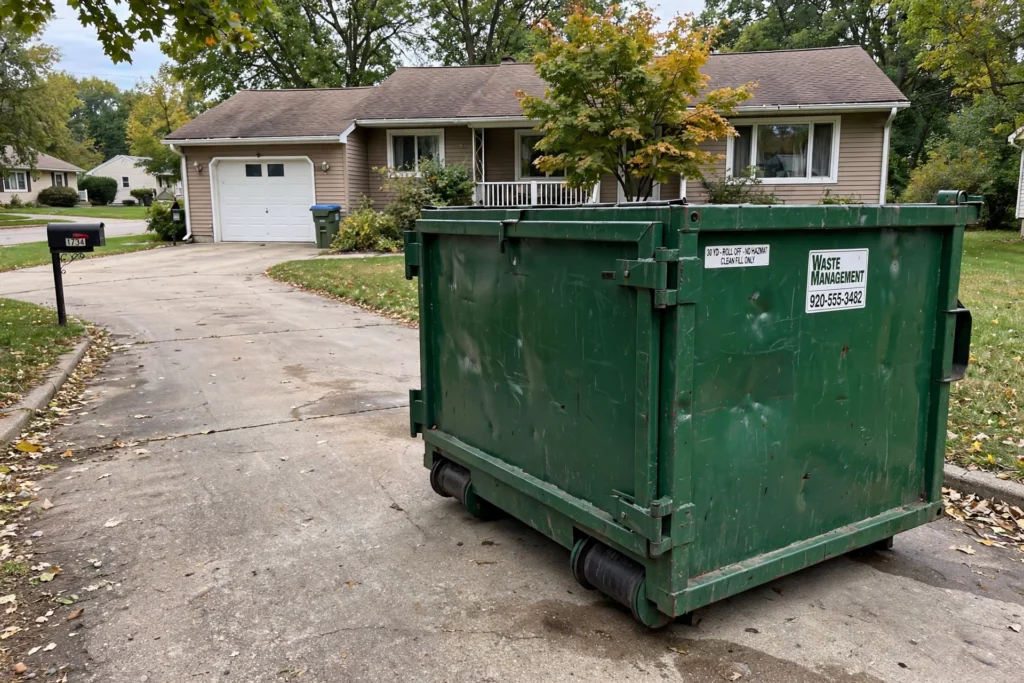
Street, sidewalk, and alley placement: what changes
Street placement brings three extra jobs: the permit, the barricades, and the neighbours. Barricades or cones may be required to keep the box visible and to keep traffic clear, and the municipality or the provider will tell you what is expected at your address. Do not assume cones from a previous job are enough, and do not block a sidewalk or a fire lane to make room for the box. If the box must go partly on the street because the driveway cannot take it, that partial street placement still counts as a right-of-way placement for permit purposes in most cases, so confirm it rather than treating it as a driveway job.
Alleys deserve a direct warning. Most Green Bay alleys are too narrow or too low for a roll-off truck to back into safely, and a corner lot with a wide alley is the exception, not the rule. If your only access is an alley, describe its width, surface, overhead wires, and turning room on the call, and accept the provider’s judgement if they say the truck cannot use it. A failed alley delivery wastes the day and can still leave you with a delivery or trip charge, depending on the provider’s terms.
Can you put a dumpster on the lawn?
A lawn is a poor default spot for a loaded dumpster. The truck and the box can rut and sink the lawn, especially when the ground is wet, thawing, or recently rained on. In spring, when the ground is soft, that risk is higher. If a lawn is the only option, ask the provider before delivery whether they will place there at all, what protection they use, and what happens if the ground gives way. Do not place a box on a lawn without asking, and do not assume the provider will accept lawn placement just because the driveway is full. The same caution applies to grass beside a driveway, a side yard, or any unpaved surface that looks firm in dry weather and softens after rain.
Snow, ice, and steep driveways
Green Bay averages about 55.6 inches of snow per year, with a January mean high around 25.5 degrees Fahrenheit, so winter placement is a real planning item, not a footnote. Before a winter delivery, clear snow and ice from the delivery spot and from the truck’s approach, and tell the provider if the driveway is steep or icy. A truck that cannot stop safely or back in safely may not deliver, and a box placed on ice can shift as the ice melts. In spring, soft ground and road weight limits add a second problem, covered on the winter and spring guide. For this page, the rule is simple: prepare the spot for the season you are in, and tell the provider about slope, ice, and soft ground before the truck is on its way.
What cannot go in a rented dumpster in Green Bay?
Two layers of rules apply, and both matter. The first is the provider’s restricted-items list. The main Green Bay competitor lists, among other items, lead-acid batteries, fluorescent lamps, asbestos, gas, oil and liquids, wet paint, radioactive and medical waste, flammable or explosive material, large appliances, tires, and electronics including computers, monitors, printers, phones, DVD and VCR players, and fax machines. Other providers have similar lists with small differences, so the provider on your call is the final word for your rental.
The second layer is Wisconsin law. The Wisconsin Department of Natural Resources landfill bans include electronics, major appliances, lead-acid batteries, waste oil and filters, tires, and paper and containers that belong in recycling. Yard waste has been banned from Wisconsin landfills since 1993, and tires since 1995. Those bans do not mean every one of those materials can never go in any dumpster. They mean the provider and the disposal site have rules for them, and you must ask before you load them. A clean metal or clean concrete load, for example, is often handled differently from mixed debris, because it can be recycled. Ask, do not assume.
The appliance question: two provider positions, stated honestly
Appliances are the one item where Green Bay providers do not agree, and this page does not pick a side without a source. Toss N Haul’s published position allows non-freon appliances, while the main Green Bay competitor bans washers, dryers, and fridges in its restricted list. Those are provider-dependent positions, not a single Green Bay rule. If your load includes an appliance, name the exact appliance on the call — washer, dryer, fridge, freezer, stove — and ask whether that provider accepts it, whether refrigerant matters, and whether there is an extra charge or a separate route. Do not load an appliance on the strength of one provider’s page and then book with a different provider.
The same ask-first rule applies to any item you are unsure about. Paint in liquid form, solvents, chemicals, asbestos, medical waste, and anything flammable or explosive should never be loaded on a guess. If you are unsure about one item, leave it out and ask. That one question is cheaper than any alternative.
What happens if a prohibited item is loaded?
A prohibited item can mean a rejected pickup, a return trip, or an extra disposal charge, depending on the provider’s terms. In the worst case, the box sits full on your driveway while the item is sorted out, and the job stalls. At the curb, the consequence is separate and specific to Green Bay: construction, remodeling, and demolition trash, appliances, electronics, and move-out debris are prohibited at the curb and at the East and West municipal drop-offs, and material left out in violation can be charged to the property owner. That curb rule is why a dumpster, used correctly, is often the only legal route for a remodel or move-out job. It is also why loading a banned item into a dumpster does not solve the problem — it moves the problem from the curb to the box, where it still has to be dealt with.
How to prepare the spot: a short checklist
Use this checklist before delivery day, and run through it on the call if anything is unclear. First, confirm the placement: fully on a private driveway, or partly or fully on a street, sidewalk, alley, or right-of-way. Second, if it is not fully on a driveway, confirm the permit with the municipality and tell the provider whether they need a copy. Third, measure the spot and the approach, check overhead clearance, and clear vehicles, snow, ice, and obstacles. Fourth, ask about driveway protection and whether boards are recommended. Fifth, list every questionable item — appliances, electronics, paint, chemicals, tires, batteries — and get a yes or no for each before delivery. A ten-minute call with that list prevents the most common permit and prohibited-item problems in Green Bay.
Internal links
- Green Bay dumpster rental guide
- Where construction debris goes in Green Bay
- What can be recycled in a Green Bay dumpster
- How much a dumpster costs in Green Bay
- Winter and spring dumpster tips for Green Bay
Call now — confirm permit and placement before you book
Call: (920) 274-9992
Before you call, have these five facts ready:
- Size or job — or the job, so the provider can size the box
- Material — including any appliance, electronic item, paint, or chemical you are unsure about
- Address/ZIP — the exact delivery address, so the municipality rule can be checked
- Date you need it, and how many days you need it
- Placement — driveway, or street, sidewalk, alley, or lawn
On the call, ask whether a permit is needed for your placement, whether the provider needs a copy before delivery, what barricades are expected, and whether each questionable item is accepted. The provider confirms price, days, tons, delivery, and pickup for your specific job.
Lead-gen disclosure
This website is a lead-generation website. When you call the number on this page, you will be connected to an independent local dumpster provider through a call network. This website is not the hauler, owns no trucks or dumpsters, sets no price, and guarantees nothing — not size availability, delivery, pickup, days, tons, or a permit outcome. The provider on the call confirms price, days, tons, overage, delivery window, pickup process, and any permit need for your address. If a provider’s answer differs from a range on this page, the provider’s answer for your specific job controls.