
OVERWEIGHT & FEES
Dumpster Overweight and Hidden Fees Checklist in Green Bay, WI
Use this checklist before you agree to a dumpster in Green Bay, because the headline price is rarely the total price. Confirm tons included, the per-ton overage rate, days included, the extra-day rate, and any trip or swap fee on the call, and ask for a scale ticket if you want weight proof.
Checklist: ask these before you agree to anything
Work through this list on the call, in order, and write the answers down with the date. If the provider cannot answer a line, do not guess it. Ask again, or call another provider.
Before delivery
- [ ] What size box, and what is the total price for that size for my job?
- [ ] How many tons are included in that price?
- [ ] What is the per-ton rate over the cap? Example, competitor-published, checked October 2026: the main Green Bay competitor’s pricing page lists $89 per ton over the cap. That is a competitor-published example, not a quote from this site. Confirm your provider’s rate on the call.
- [ ] How many days are included, and what is the per-day rate after that period ends?
- [ ] Is there a trip fee if the truck cannot deliver or pick up? Example, competitor-published, checked October 2026: the main Green Bay competitor’s pricing page lists a $150 trip fee. That is a competitor-published example, not a quote from this site. Confirm your provider’s fee on the call.
- [ ] Is there a fee for a swap if the box fills early, and what is that fee? No swap-fee amount is stated here, because no verified Green Bay swap fee was in the brief. Ask and record the amount.
- [ ] What is the fill line for my material, especially for heavy material?
- [ ] Can I ask for a scale ticket for my load?
- [ ] What items are prohibited, and what happens if a prohibited item is found?
- [ ] Does the box go on the driveway or the street, and is a municipal permit needed?
While you load
- [ ] Load to the fill line only, never above it, even if space seems left at the ends.
- [ ] Keep heavy material separate in your mind from light material: shingles, concrete, dirt, and brick hit weight first.
- [ ] Do not add a prohibited item to “save a trip.” It can reclass the load or block pickup.
- [ ] If the box is filling faster than expected, call about a swap before it is overfull, not after.
After pickup
- [ ] Ask when the final weight and any overage charge will be confirmed.
- [ ] Ask for the scale ticket if you asked for one before delivery.
- [ ] Check the final bill against the five numbers from the call: size, price, days, tons, and overage rate.
- [ ] If a charge appears that was not discussed, ask what it is for, in writing, before paying it.
Why is a half-full heavy box the most common surprise?
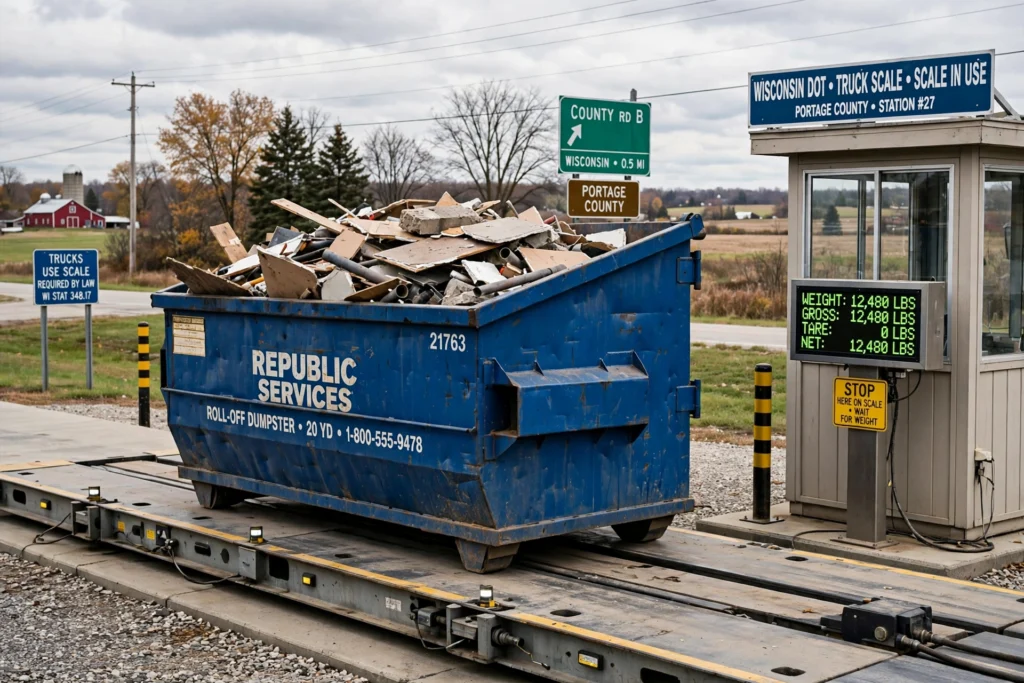
Because a dumpster has two limits, and people usually watch only one. Volume is what you can see. Weight is what you pay for when you go over the cap. Household junk usually fills by volume first: the box looks full before it is heavy. Concrete, dirt, brick, asphalt, and roofing shingles do the opposite. They hit the weight limit first, while the box still looks half full.
That is why a roofing tear-off, a driveway removal, or a basement full of wet material can produce an overweight charge even when the renter was careful not to overfill the box. The renter filled by eye. The provider weighs by ton. The checklist above closes that gap by making tons, not just cubic yards, part of the decision before delivery.
In Green Bay, this risk is higher than in a new-build market. With a median home build year of 1971 and about 48 percent of homes built before 1970, remodel, roofing, and cleanout loads are often mixed and heavy: old timber, plaster, shingles, flooring, and household items in one box. Mixed heavy loads are exactly the loads where a ton cap matters most, so ask about the mixed-load cap, not just the headline size.
What does the extra-day rate really cost in Green Bay?
This is where Green Bay pricing is genuinely inconsistent, and this page states that inconsistency honestly rather than picking one number. The main Green Bay competitor’s homepage, checked October 2026, says $10 per day past its 15-day base period. The same competitor’s pricing page, checked October 2026, says $21 per day past the period. Both figures are competitor-published, checked October 2026, and they conflict with each other.
A second competitor-published example shows the same point from a different angle. Toss N Haul’s published Green Bay terms, checked October 2026, list 7-day rentals, 14 days for an extra $50, extra days at $10 per day, and a $65-per-ton disposal note. That is a different base period, a different extra-day structure, and a different per-ton figure from the main competitor. Neither example is a quote from this site, and neither should be treated as your rate.
The lesson is not to memorise $10 or $21. The lesson is to confirm three things together on your call: how many days are included, what the per-day rate is after that period, and whether the count starts on delivery day or the day after. A job that runs two days over can cost very different amounts depending on those three answers, and a provider who cannot state them clearly is a warning sign.
What is a trip fee, and when does it apply?
A trip fee is a charge for a wasted trip: the truck arrives to deliver or pick up, and cannot complete the job. Common causes are a blocked driveway, a car in the placement spot, a locked gate, low wires, an overfilled box, a prohibited item, or a placement spot the truck cannot safely reach. The fee covers the truck’s time and fuel for a trip that produced no delivery or pickup.
Example, competitor-published, checked October 2026: the main Green Bay competitor’s pricing page lists a $150 trip fee. That is a competitor-published example, not a quote from this site. Confirm whether your provider charges a trip fee, how much it is, and what triggers it, before delivery day. Then prevent it: clear the spot, move vehicles, check overhead clearance, keep the box at or below the fill line, and tell the provider about any access problem before the truck leaves, not when it arrives.
A swap fee is different from a trip fee. A swap is a planned exchange: a full box is picked up and an empty box is delivered so work can continue. A trip fee is for a failed visit. Ask about both, separately, because a provider may charge one and not the other, or charge both at different rates.
Can I be charged after pickup, and what is the national pattern?
Yes, a final weight-based charge can appear after pickup, because the box is weighed at the disposal site after it leaves your property. That timing is normal. What is not normal, and what you should watch for, is a charge that was never discussed on the call, with no weight evidence offered when you ask for it.
The pattern of post-pickup charges appearing without a clear weight breakdown is a NATIONAL pattern in dumpster rental complaints and advice, not a verified Green Bay case. This page does not claim that any named Green Bay provider has done this, because no verified Green Bay case was in the brief. The national pattern is included only as a reason to ask for a scale ticket and to get tons, overage rate, and final-bill timing in writing before delivery.
Your protection is simple and does not depend on trusting any provider. Ask for a scale ticket before delivery, record the five call numbers, and check the final bill against them. If the final bill differs, ask for the weight evidence. A provider who can show the scale ticket has answered the question. A provider who cannot should be asked, politely and in writing, to explain the charge.
What should I do if the final bill is higher than the call quote?
First, compare the bill line by line with your call notes. Was the size the same? Were the days the same? Were the tons included the same? Was the overage rate the same? Most surprises come from one of those five lines changing, not from a mysterious new fee.
Second, ask for the scale ticket and the calculation: total weight, minus tons included, times the per-ton rate, plus any extra days and any trip or swap fee. If any line on the bill does not match your call notes, ask about that line specifically, rather than disputing the whole bill at once.
Third, keep the call notes, the scale ticket if you have one, and the final bill together. If you need to follow up, those three documents are the whole case. This site does not handle billing disputes, because it is not the hauler and does not set the provider’s price. The dispute, if there is one, is between you and the provider, and it is settled faster when you can show what was agreed on the call.
Internal links
- Pillar guide: Dumpster rental in Green Bay, WI
- Dumpster rental costs in Green Bay
- What size dumpster you need in Green Bay
- Concrete loads in Green Bay
- Yard waste and storm debris in Green Bay
- Dumpster rules and permits in Green Bay
Call CTA
Call now: (920) 274-9992
Before you call, have these five facts ready:
- Size or job — cleanout, remodel, roofing, concrete, or yard job, and roughly how much material
- Material — light household junk, or heavy material such as shingles, concrete, dirt, or brick
- Address/ZIP — Green Bay or a core suburb, with the exact placement spot
- Date/days — when you need the box, and how many days you need it
- Driveway vs street — driveway placement, or street, sidewalk, or right-of-way placement
Lead-gen disclosure
This website is a lead-generation website. When you call the number on this page, you will be connected to an independent local dumpster provider through a call network. This website is not the hauler, owns no trucks, sets no price, and guarantees nothing. The provider confirms price, days, tons, overage rate, extra-day rate, trip fee, swap fee, delivery, pickup, and any permit requirement for your specific job on the call. If the provider’s answer differs from a range or example on this page, the provider’s answer controls.