
Garage and Basement Cleanout Dumpster in Green Bay, WI
For a garage basement cleanout dumpster Green Bay job, sort as you go and size by what you are throwing away, not by room size. Furniture, mattresses, and boxes fill a box by volume, while old tools and stored material can add weight and prohibited items. Call with a list, and the provider can confirm size, days, and ton cap.
Sort as you go, or the job stalls
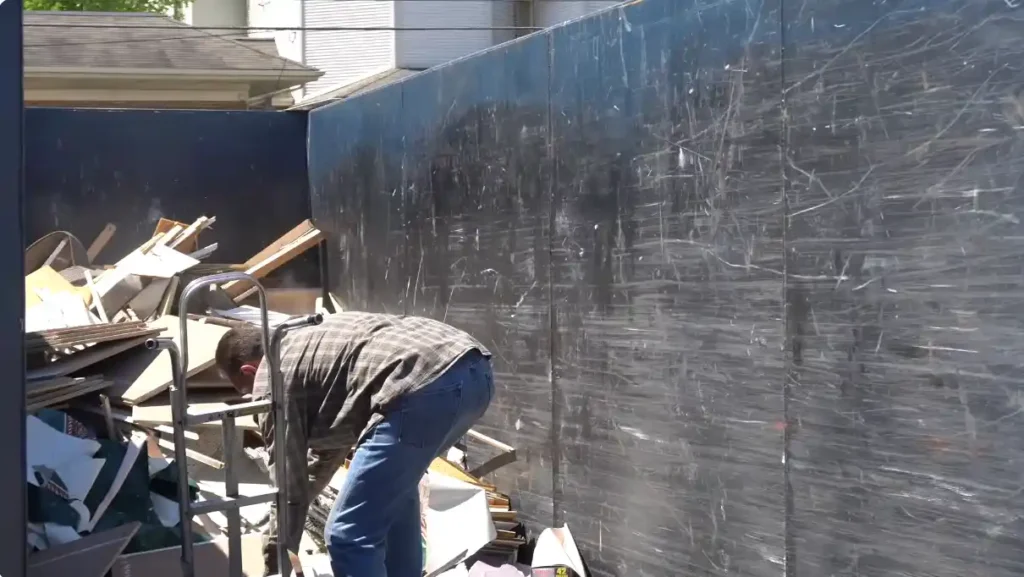
A garage or basement cleanout is different from a remodel, because the work is deciding, not demolishing. The pile did not appear in a day, and it will not disappear in an hour. The method that works is sorting as you go, in three piles, before anything goes in the box: keep, donate or give away, and throw away. Do not start by loading the box. Start by clearing a sorting area — a driveway section, a cleared corner of the garage, or a tarp on the lawn — and work through one section at a time: one wall, one shelf, one corner. When a section is sorted, the throw-away pile goes in the box, the keep pile goes back in an organised spot, and the donate pile goes out the door. That rhythm keeps the job moving and keeps you from loading something you meant to keep, which is the most common regret on a cleanout.
Green Bay homes make this job bigger than it looks. The median home was built in 1971, and about 48% of homes are pre-1970, so many garages and basements hold decades of stored material: furniture from a previous room, boxes never unpacked, old appliances, tools, and household items that were stored “for now” and stayed. A cleanout that starts as “just the garage” often turns into a garage plus a basement corner, plus an attic box or two. Tell the provider the full scope as you understand it on the first call, and ask about a swap if the box fills early. It is easier to plan for a swap you do not need than to stall a cleanout for a day because the box is full and no swap was arranged.
What size fits a garage or basement cleanout?
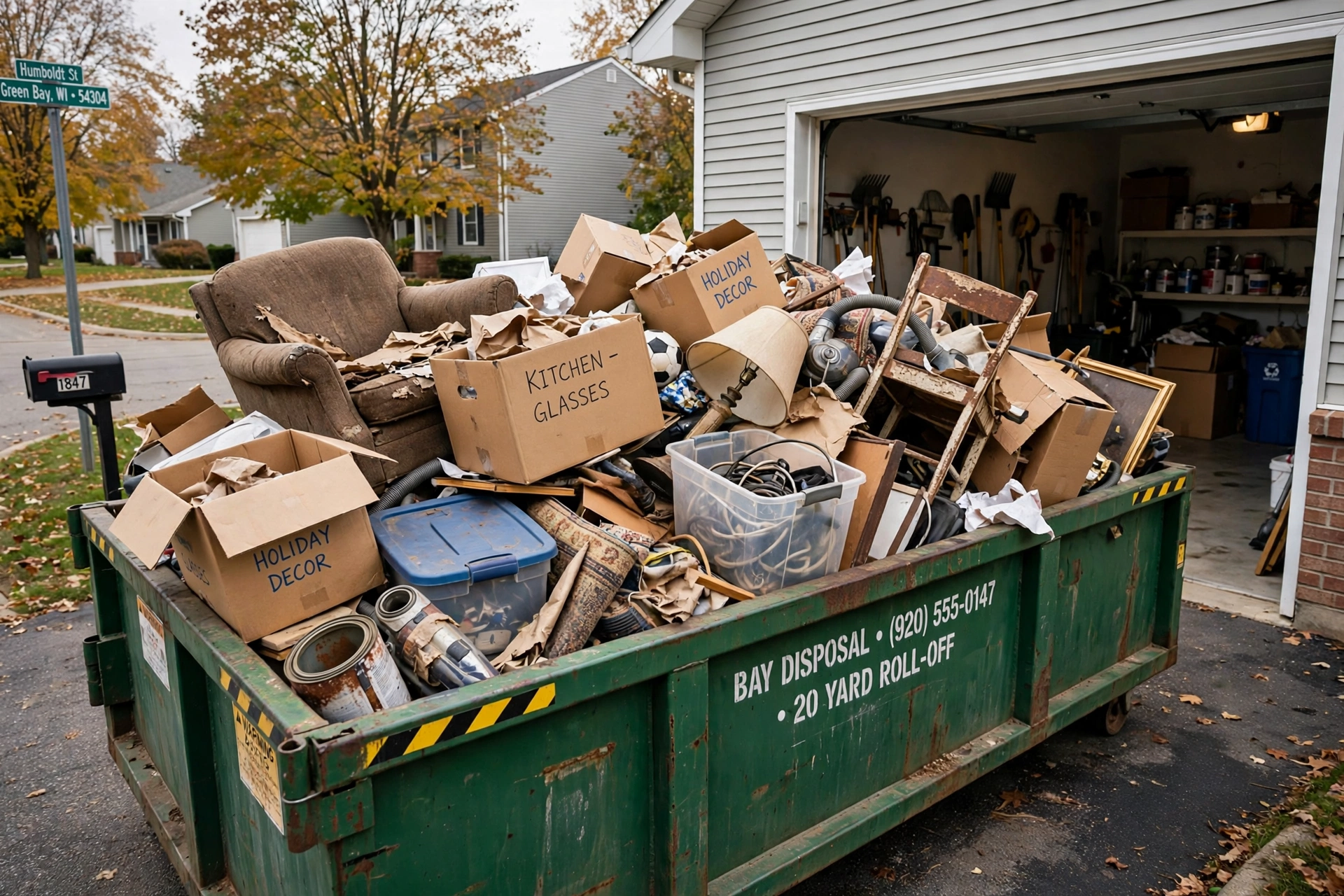
Use volume first, then check weight and prohibited items. The Green Bay volume guides are: a 10-yard box holds about 3 pickup loads, a 15-yard box about 4 to 5 loads, a 20-yard box about 6 loads, and a 30-yard box about 9 loads. A single-car garage cleanout with mostly boxes, old furniture, and light household items often fits a 10-yard or 15-yard box. A two-car garage, a full basement, or a garage plus basement job usually needs a 15-yard or 20-yard box. A whole-house cleanout that starts in the garage and basement is a different job — it is covered on the estate cleanout page, not sized here as a garage job.
| Job | Starting size to discuss on the call | What fills it | Watch out for |
|---|---|---|---|
| Small garage or single basement room | 10-yard | Boxes, light furniture, household items | Heavy stored material and prohibited items hiding in boxes |
| Full garage cleanout | 15-yard | Furniture, mattresses, boxes, old household items | Mattresses and furniture are bulky — break down what you can |
| Full basement cleanout | 15-yard | Furniture, boxes, stored household items | Damp or wet material — ask the provider about wet loads before loading |
| Garage plus basement | 20-yard | Mixed household junk from both spaces | Sorting time — plan more days, not just a bigger box |
| Garage plus basement plus more rooms | 20-yard with a swap plan, or 30-yard for light debris only | Light, bulky household junk | A 30-yard of heavy material will exceed its ton cap |
If you are between two sizes for light household junk, size up. The price difference between sizes is usually smaller than the cost of a second delivery or a swap in the middle of a cleanout. For heavy stored material — old tools, metal, books in bulk, or construction material stored in the garage — call first and ask about the ton cap. Household junk usually fills by volume first. Heavy stored material can hit weight first, even when the box does not look full.
Furniture, mattresses, and boxes
Furniture, mattresses, and boxes are the bulk of most garage and basement cleanouts, and they need a loading plan, not just a box. Break down furniture where you can — remove legs, take apart shelving, flatten boxes — because broken-down material loads level, uses the volume you paid for, and respects the fill line. Load heavy items low and bulky items on top, and do not let anything stick above the rim. A box loaded above the fill line may be refused for pickup or may trigger a trip fee, and a cleanout that ends with a refused pickup is a cleanout that is not finished.
Mattresses deserve a specific mention on the call. Tell the provider how many mattresses are going in, because providers handle them differently and some charge or restrict them. Do not assume a mattress is just another bulky item. The same rule applies to old carpet, large rugs, and upholstered furniture: name them on the call, so the provider confirms acceptance and any extra handling before delivery, not after loading.
Boxes are the opposite problem. They look light, but a garage full of boxes can fill a box fast if they are not flattened, and boxes full of books, tools, or stored material can be heavy. Flatten empty boxes, and sort full boxes before they go in — a box of books is not the same load as a box of old clothes, and a box of forgotten paint, oil, or chemicals is not a dumpster load at all. Which brings us to the section that saves cleanout callers the most trouble.
What cannot go in, and what the curb cannot take
Before you load, pull out anything that cannot go in a rented dumpster. That includes hazardous materials, liquids, and Wisconsin-banned items: hazardous chemicals, asbestos, paint and solvents in liquid form, motor oil and other automotive fluids, lead-acid batteries, tires, electronics including computers, monitors, printers, and phones, fluorescent lamps, medical waste, and flammable or explosive material. Large appliances are restricted in many providers’ terms, especially appliances with refrigerant, and providers differ on appliances — so appliance acceptance is presented here as provider-dependent, and you should ask on the call rather than assuming. Wisconsin Department of Natural Resources landfill bans include electronics, major appliances, lead-acid batteries, waste oil and filters, tires, and paper and containers that belong in recycling, with yard waste banned since 1993 and tires since 1995. Garages and basements are exactly where these items hide: old paint in the garage, a dead battery, an old television in the basement, a tyre in the corner. Pull them out during sorting, set them aside, and ask the provider or your local disposal route how each one should be handled. Loading them and hoping is how a pickup gets rejected.
The curb is not a backup for the rest, either. In Green Bay, construction, remodeling, and demolition trash, appliances, electronics, and move-out debris are prohibited at the curb and at the East and West drop-offs at 1820 Mills St and 519 S Oneida St, and are charged to the property owner if left out. For small household items that do fit the city rules, Green Bay’s free options in 2026 were bulk pickup weeks March 30 to April 3 (rescheduled) and September 21 to 25, up to 2 cubic yards free, set out by 6 a.m., and overflow weeks March 16 to 20, July 6 to 10, September 14 to 18, and December 28 to January 2, up to four 32-gallon bags. If your cleanout fits those limits, use them — they are free. If it does not fit, or it includes construction debris, appliances, electronics, or move-out material, do not leave it at the curb. That is the exact situation a dumpster is built for. Construction debris, where it appears in a garage or basement job, is directed to the Brown County Transfer Station at 3734 W Mason St, whose current fee is unverified and is not stated here.
Damp and flooded basements: ask before you load
A damp or flooded basement needs a different conversation before loading. This page makes no health or mould claim, and it does not diagnose anything in your basement. The practical point is simpler: wet material is heavier, it can change how a load is handled, and some providers have rules about wet loads. If your basement has standing water, damp boxes, wet carpet, or material that has been wet for a while, tell the provider on the call and ask about wet material before you load it. Do not mix wet material silently into a general cleanout load and hope the provider does not notice the weight. Asking first lets the provider set the size, the ton cap, and the loading plan correctly, and it lets you decide whether part of the job — drying, separating, or a separate disposal route — needs to happen before the dumpster arrives. If you are unsure whether material is safe to handle, ask a professional before you handle it. This page does not answer that question, and it does not pretend to.
Season matters here too. Green Bay averages about 55.6 inches of snow per year, with a January mean high around 25.5 degrees Fahrenheit and a July mean high around 81.0 degrees Fahrenheit. In winter, clear snow and ice from the delivery spot before the truck arrives. In spring, Wisconsin road weight limits — typically 6 tons single axle and 10 tons tandem, typically mid-March to mid-April — can affect heavy hauls and delivery timing, so ask on the call if your job falls in that window. A cleanout that starts in a wet spring basement and ends with a heavy load is exactly the job where the ton-cap question matters most.
How many days does a cleanout need?
More than you think, and that is normal. A cleanout is a deciding job, and deciding takes time. A garage cleanout done in evenings after work takes several days. A basement cleanout with family members deciding what to keep takes longer still. Tell the provider how many days you actually need, not how many days you hope to need, and ask what extra days cost and how a swap works if the box fills early.
The cost figures below are competitor-published market ranges, checked October 2026, confirm on the call. The main Green Bay competitor published online prices of 10-yard $480, 15-yard $490, 20-yard $495, and 30-yard $515 for a 15-day base, with city ranges of 10-yard $480 to $560 for 1 ton, 20-yard $495 to $670 for 1 to 2 tons, and 30-yard $515 to $695 for 2 to 3 tons, plus $89 per ton over the cap, $21 per day past the period on its pricing page ($10 per day on its homepage — ask which applies), and a $150 trip fee. Toss N Haul published 10-yard $300 for 2 tons, 15-yard $350 for 3 tons, and 20-yard $400 for 4 tons, for 7 days, with 14 days adding $50 and extra days at $10 per day. A longer base period can matter on a cleanout, because a 15-day rental covers a sorting job better than a 7-day rental that runs into extra-day charges while you are still deciding. Compare any quote on size, days, tons, and overage together, never on headline price alone.
Placement for a garage or basement job
A driveway placement generally does not need a permit. A street, sidewalk, or right-of-way placement generally does, from the municipality, and no Green Bay street permit fee or timeline is verified in this research, so this page does not state one — confirm it with the city or your village or town before you schedule a street placement. For a garage cleanout, placement is usually straightforward: the box goes in the driveway, close to the garage, so the walk from sorting pile to box is short. For a basement cleanout, the walk is longer — through the house, up the stairs, out the door — and that distance is a planning point. Clear the path before delivery day, protect floors and stairs where the crew will carry material, and agree on where the box sits so the carrying route is as short and safe as possible. Tell the provider about overhead wires, a narrow driveway, or a steep approach, and mark the spot. Do not place a loaded box on a lawn without asking.
Questions cleanout callers ask
Will a couch fit in a 10-yard dumpster?
Yes, a standard couch will fit in a 10-yard dumpster, as long as it is broken down or placed so it does not stick above the fill line, and as long as the total load stays within the provider’s ton cap. A couch plus a room full of furniture, mattresses, and boxes is usually a 15-yard or 20-yard job, not a 10-yard job.
Can I put old paint and oil in the dumpster?
No — paint and solvents in liquid form, motor oil, and other automotive fluids cannot go in a rented dumpster, and they are part of the Wisconsin-banned and provider-prohibited lists. Set them aside during sorting and ask the provider or your local disposal route how to handle them.
What if the box fills before I finish sorting?
Ask about a swap before delivery, not after the box is full. A swap means the provider picks up the full box and drops an empty one. Ask whether there is a fee, how much notice is needed, and whether the swap resets the rental days or continues them.
Can I load wet basement material in the dumpster?
Ask the provider about wet material before you load it. Wet material is heavier and may be handled differently, and this page makes no health claim about damp or flooded basements. Tell the provider what is wet, ask what they accept, and get the answer before delivery.
Internal links
- Green Bay dumpster guide — the pillar guide for sizes, costs, permits, and disposal across Green Bay
- What size fits your job
- Green Bay cost ranges and how to compare them
- Permit and placement rules to check before delivery
- Where construction debris goes in Brown County
Call now — garage and basement cleanout
Call (920) 274-9992
Before you call, have these five facts ready:
- Size or job — garage, basement, or both, and roughly how much there is
- Material — furniture, mattresses, boxes, household junk, or mixed, plus anything heavy or prohibited you have set aside
- Address and ZIP — your Green Bay address, so the provider can confirm coverage
- Date and days — when you need delivery, and how many days sorting will take
- Placement — driveway or street, and a description of the spot and access
Lead-gen disclosure
This website is a lead-generation website. When you call the number on this page, you will be connected to an independent local dumpster provider through a call network. This website is not the hauler, does not own dumpsters or trucks, does not set the provider’s price, and does not guarantee delivery, pickup, size availability, or a permit outcome. Your exact price, days, tons, overage rate, delivery window, and pickup process are confirmed by the provider on your call. If a provider’s answer differs from a range on this page, the provider’s answer for your specific job controls.