
WINTER & SPRING
Winter and Spring Dumpster Rental in Green Bay, WI
Answer first: Winter dumpster rental in Green Bay means clearing snow and ice from the delivery spot, telling the provider about steep or icy driveways, and covering the load. In spring, thaw weight limits — 6 tons single axle and 10 tons tandem, typically mid-March to mid-April — can delay heavy hauls. Confirm delivery, pickup, and storm delay on the call.
Why Green Bay winters change a dumpster job
Green Bay averages about 55.6 inches of snow per year, with a January mean high around 25.5 degrees Fahrenheit and a July mean high around 81.0 degrees. That is not a footnote for a dumpster job. It is the difference between a delivery that happens on schedule and a truck that cannot safely back into a driveway, a box that sits on ice and shifts as the ice melts, and a load that gains weight from snow and rain before pickup. A dumpster job in January is a different job from the same job in June, even if the size, material, and address are identical.
The housing stock adds to the winter picture. The median Green Bay home was built in 1971 and about 48 percent of homes are pre-1970, so winter work here is often a remodel, a cleanout, or a roof job on an older home, with a driveway that is narrow, sloped, or shared. A new subdivision with wide, flat driveways would hide many of these problems. Green Bay’s older lots do not. Measure the driveway, check the slope, and look for ice before the truck arrives, because the provider can only work with the spot you describe honestly on the call.
How to prepare a winter delivery spot
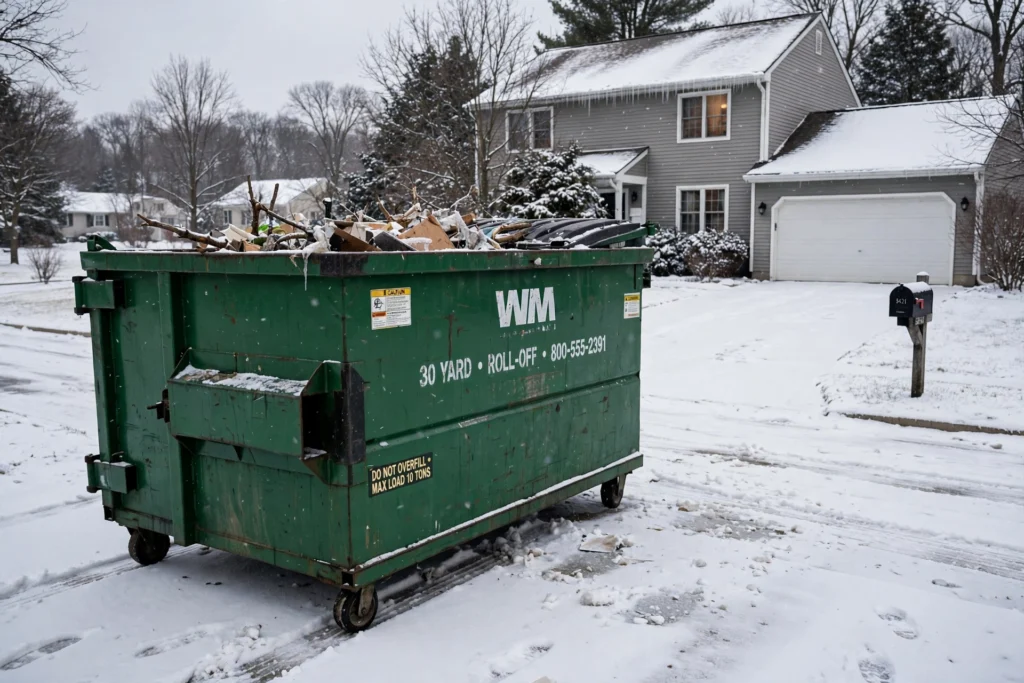
Clear snow and ice from the delivery spot and from the truck’s approach before the delivery window, not after the truck arrives. That means the full footprint of the box, plus the path the truck uses to back in and roll the box off. Salt or sand the approach if ice is likely to reform, and keep the spot clear until pickup as well, because a pickup truck faces the same ice problem as a delivery truck. If the driveway is steep, tell the provider before booking. A steep, icy driveway may need a different placement spot, a smaller box, or a different delivery day, and the provider’s judgement on that point should be accepted rather than argued with on the day.
Overhead clearance matters more in winter, because low branches sag under snow and ice. Providers typically need about 14 feet of overhead clearance, so check wires and branches with snow load in mind, not just in summer shape. Clear vehicles from the spot, mark where you want the box, and tell the provider about gates, fences, and tight turns. If the box must go on the street rather than the driveway, the permit question from the rules and permits page applies in winter too, and barricades in snow need to stay visible. Do not assume a street placement that worked in summer works unchanged in a snowbank.
Should you cover a dumpster in winter?
Covering a dumpster is a practical question, not a cosmetic one, and the answer depends on the provider and the load. An uncovered box collects snow and rain, and that water adds weight. On a light household load, the added weight may not matter. On a load that is already near its ton cap — especially a heavy load of shingles, concrete, or wet debris — snow and rain weight can push the load over the cap and into overage charges. A cover, a tarp, or the provider’s own covering method can prevent that, but only if the provider allows or supplies it, and only if the cover is secured so it does not blow off in a Green Bay wind.
Ask the provider on the call whether covering is expected, allowed, or supplied for your rental, and how an uncovered load is weighed. Do not improvise a cover that blocks the fill line or makes pickup unsafe. The main competitor’s news section includes a post on whether to cover a dumpster, which shows the question is common, but this page does not copy its answer. Your provider’s answer for your box, your material, and your rental period is the one that controls. If you are keeping a box over a snowy weekend or through a storm, covering it is worth asking about before the snow arrives, not after the box is already full of snow.
What happens in a storm: delays are conditional, not guaranteed
Storm delays are the one winter topic where this page must be careful. No delivery window is guaranteed by this site, and no provider’s storm policy is stated here as fact, because storm policies vary by provider and by storm. What can be said honestly is this: heavy snow, ice, and high winds can delay delivery and pickup, because a roll-off truck cannot safely operate on an uncleared, icy, or blocked route. If a storm is forecast during your rental period, tell the provider, ask how they handle rescheduling, and ask whether extra days caused by a storm delay are charged at the normal extra-day rate or handled differently. Get that answer before the storm, not after the truck fails to arrive.
The same conditional logic applies to pickup. If the box is ready but the driveway is buried, the truck cannot pick it up, and the rental period may run on while you clear the spot. Clearing the spot before the pickup window, keeping the approach salted, and telling the provider as soon as you know the spot is blocked are the three things within your control. Everything else — the provider’s storm schedule, their route order, and their extra-day policy — is confirmed on the call. Do not promise a contractor or a crew a pickup time this site has not guaranteed, and do not assume a storm delay is free.
Spring thaw: weight limits that affect heavy hauls
Spring brings a different problem from winter, and it is easy to miss because the weather feels easier. In Wisconsin, spring road weight limits typically apply at 6 tons for a single axle and 10 tons for a tandem axle, typically from mid-March to mid-April. Those limits can affect heavy hauls and delivery timing, because a loaded truck that is legal in June may exceed a posted spring limit in March. The limits are typically seasonal and route-specific, so the exact roads, dates, and limits for your haul are confirmed by the provider, not assumed from this page.
For a heavy job — concrete, dirt, brick, asphalt, or a full roof tear-off — spring thaw is a reason to call earlier and to ask directly. Ask whether the weight limits affect your delivery or pickup dates, whether a smaller box or a lighter load per haul is needed during the thaw period, and whether the ton cap for your size changes in spring. For a light household cleanout, thaw limits are less likely to change the plan, but they are still worth mentioning if the delivery route uses a posted road. Do not assume a heavy concrete load can be hauled on the same schedule in March as in June. Ask on the call, and let the provider set the date around the limits.
Spring ground conditions add a second problem. A lawn or an unpaved spot that looked firm in winter can soften as the ground thaws, and a loaded dumpster on soft ground can rut or sink. The rules and permits page warns against lawn placement without asking, and that warning is strongest in spring. If the driveway is soft, cracked, or newly thawed, say so on the call and ask about boards or an alternative spot. A box placed on soft ground in March can be harder to pick up in April.
How long can you keep a dumpster in winter and spring?
Rental days vary by provider, and the published Green Bay figures show the range. The main competitor publishes a 15-day base, while other Green Bay listings use 7 days, as competitor-published market ranges, checked Oct 2026, confirm on the call. A winter or spring job often needs more days than a summer job, because weather interrupts loading, contractors reschedule, and sorting a cleanout takes longer in cold weather. If you think the job may run long, ask about the extra-day rate before the rental period ends, not after it, and ask how storm delays are treated. A longer rental with a clear extra-day rate is cheaper than a rushed job that ends with a full box, a missed pickup, and a second haul.
Loading order matters in winter too. Put flat, bulky items at the bottom, break furniture down where you can, and keep the load level with the fill line. Nothing should stick above the sides, and snow should not be allowed to pile above the fill line either, because the box must be safe to transport. If the box fills early, ask about a swap before delivery, so a full box in a snowstorm does not stall the job. If you need more days, ask before the period ends. Those two questions, asked early, prevent most winter rental surprises.
A seasonal checklist for the call
Use this checklist when you call in winter or spring, in addition to the usual five facts. Tell the provider the slope and surface of the driveway, whether ice or snow is present, and whether the spot will be cleared before delivery and pickup. Tell them the material, with special attention to heavy material in spring, when thaw limits may apply. Ask about covering the box, about storm rescheduling and extra-day charges, and about driveway protection on soft or icy ground. If the box will go on the street, confirm the permit with the municipality first, as the rules page explains. A call that covers slope, ice, thaw, cover, and storm policy is a qualified call, and it is the call most likely to get a delivery that actually happens on the day planned.
Internal links
- Green Bay dumpster rental guide
- Dumpster rental rules and permits in Green Bay
- Where construction debris goes in Green Bay
- How much a dumpster costs in Green Bay
- What size dumpster fits your Green Bay job
Call now — get a real size and price for your job
Call: (920) 274-9992
Before you call, have these five facts ready:
- Size or job — or the job, so the provider can size the box
- Material — including heavy material, if spring thaw limits may apply
- Address/ZIP — Green Bay or a core suburb, so the provider can confirm coverage
- Date you need it, and how many days you need it
- Placement — driveway, or street, alley, or lawn, plus slope, ice, and ground condition
On the call, ask about covering the box, storm rescheduling, extra-day charges, and spring thaw limits for heavy loads. The provider confirms price, days, tons, delivery, and pickup for your specific job.
Lead-gen disclosure
This website is a lead-generation website. When you call the number on this page, you will be connected to an independent local dumpster provider through a call network. This website is not the hauler, owns no trucks or dumpsters, sets no price, and guarantees nothing — not size availability, delivery, pickup, days, tons, or a permit outcome. The provider on the call confirms price, days, tons, overage, delivery window, pickup process, and any permit need for your address. If a provider’s answer differs from a range on this page, the provider’s answer for your specific job controls.