
What Size Dumpster Do I Need in Green Bay?
What size dumpster do I need Green Bay? Choose a dumpster in Green Bay by job and material, not by cubic yards alone. A small cleanout or single room usually fits a 10-yard box, a single-room remodel or standard roof usually fits a 15-yard box, and a multi-room cleanout or kitchen remodel usually fits a 20-yard box. If you are between sizes, size up.
A dumpster has two limits, not one
Every roll-off dumpster has a volume limit, measured in cubic yards, and a weight limit, measured in tons. Most people only think about volume: how much stuff will fit in the box. That works for light household junk, which usually fills the box by volume first. It fails for heavy material, which hits the weight limit long before the box looks full.
Concrete, dirt, brick, asphalt, and roofing shingles are the usual culprits. A box half full of concrete can already be over its ton cap. A box of shingles can do the same. That is the most common overweight surprise in Green Bay, and it is also the most avoidable one: tell the provider what the load is made of, before you book, and ask about the ton cap for that size.
Dimensions, truck loads, and ton caps vary by provider, so the numbers on this page are guides for choosing, not guarantees for a specific rental. The provider on the call confirms the size available, the ton cap, and the fill rules for your material.
The size table at a glance
| Size | Pickup loads, as published | Best for in Green Bay | Watch out for |
|---|---|---|---|
| 10-yard | About 3 loads | Small cleanout, single room, garage, small remodel, yard cleanup | Heavy material fills the weight limit before it looks full |
| 15-yard | About 4–5 loads | Single-room remodel, basement cleanout, standard roofing job | Shingles and concrete hit tons fast — ask about the ton cap |
| 20-yard | About 6 loads | Multi-room cleanout, kitchen remodel, large roofing job, estate cleanout | Do NOT use a 20-yard for a full concrete load — use a smaller, heavy-material box |
| 30-yard | About 9 loads | Large remodel, demolition, whole-house cleanout | Light, bulky debris only; a full 30-yard of heavy material will exceed its ton cap |
Published dimensions add useful detail where they exist. One Green Bay provider lists a 10-yard box at about 12 feet by 7 feet by 4 feet, a 15-yard box at about 15 feet by 8 feet by 5 feet, and a 20-yard box at about 15 feet by 8 feet by 6 feet. The main competitor publishes a 20-yard box at about 20 feet by 7 feet 11 inches by 5 feet, and a 30-yard box at about 20 feet by 7 feet 11 inches by 6 feet. Dimensions vary by provider, so measure your driveway against the provider’s actual box, not against a table on this page.
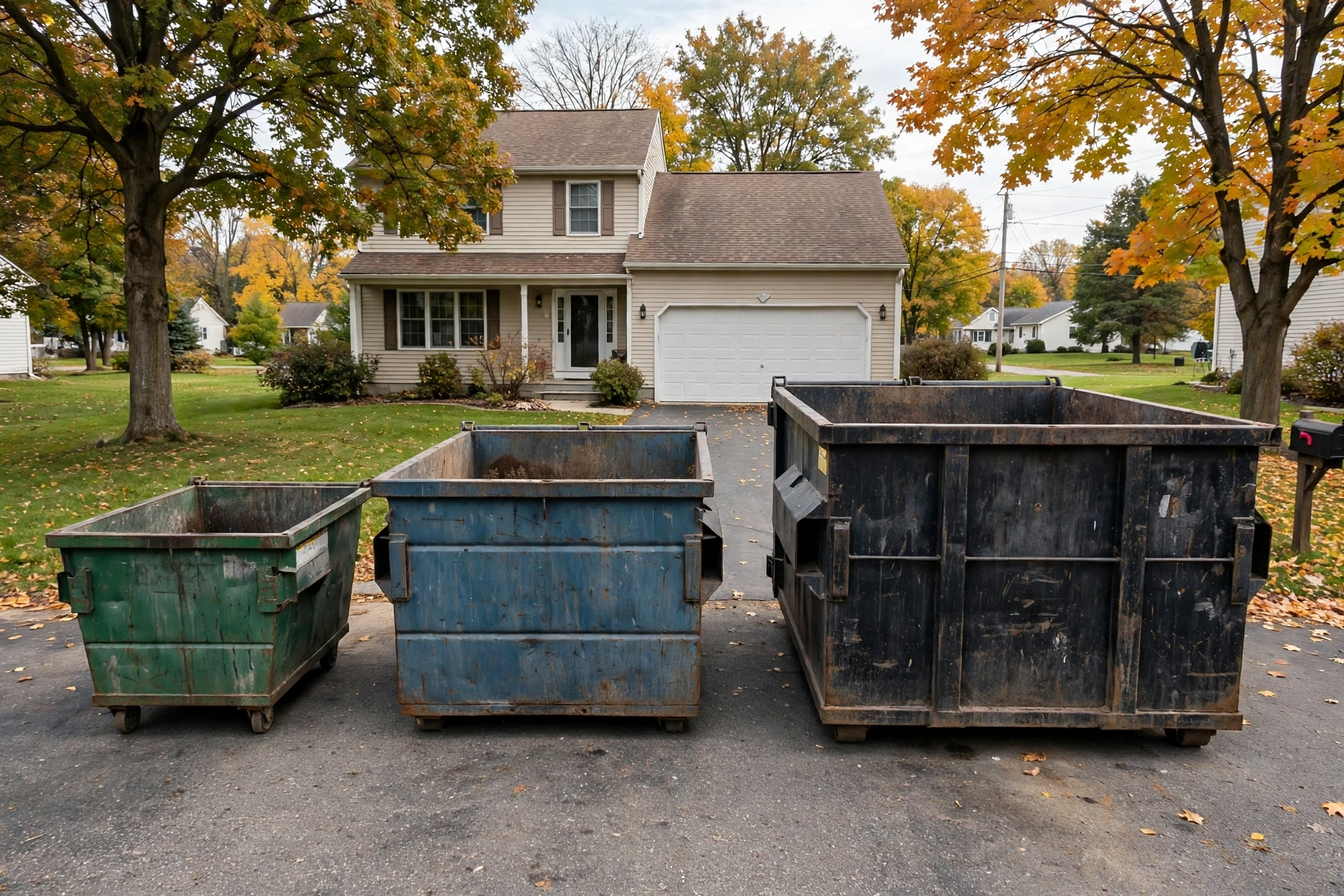
The pickup-load method: a quick check, not a final answer
Count your debris in pickup truck loads. A standard pickup bed, loaded level, is the rough unit most Green Bay guides use. A 10-yard box holds about 3 loads, a 15-yard box about 4 to 5 loads, a 20-yard box about 6 loads, and a 30-yard box about 9 loads. Walk the job, count the piles, and add one load for the things you forgot: the boxes in the attic, the broken furniture behind the garage, the bagged trash you have not counted yet.
Then adjust for weight. If your count is mostly light stuff — furniture, boxes, bagged household junk, wood trim — the pickup-load count is a fair guide. If your count is mostly shingles, concrete, dirt, brick, or wet debris, stop and call before you book. The right answer for a heavy load is often a smaller box, a heavy-material box, or a higher ton cap, not the biggest box you can fit in the driveway.
If you are between two sizes, size up. The price difference between sizes is usually smaller than the cost of a second delivery, a swap, or an overweight fee. A box that is a little too big is a minor waste of space. A box that is too small in the middle of a remodel is a second haul, a second charge, and a stalled job.
Match the size to the job
A small cleanout, a single room, a garage, a shed, or a small yard cleanup usually fits a 10-yard box. The load is light, it is mostly one or two rooms of stuff, and you can load it over a few days without needing a swap. If a couch is the biggest item, a 10-yard box can still work, as long as the couch sits below the fill line and the rest of the load stays within the ton cap.
A single-room remodel, a basement cleanout, or a standard roofing job usually fits a 15-yard box. The step up from 10 to 15 yards is the step from “one room of junk” to “one room torn apart.” Drywall, flooring, cabinets, and a basement full of stored items add up faster than people expect, and the extra loads in a 15-yard box cover that without jumping to a much bigger footprint.
A multi-room cleanout, a kitchen remodel, a large roofing job, or an estate cleanout usually fits a 20-yard box. This is the most versatile medium-large size for home jobs in Green Bay, because it balances capacity, driveway fit, and cost. It is not, however, a concrete box. A 20-yard box filled with concrete, dirt, or brick will exceed its ton cap long before it is full, and the provider may require a heavy load to be filled only partway.
A large remodel, a demolition job, or a whole-house cleanout usually needs a 30-yard box, and only for light, bulky debris. Furniture, wood, drywall, and bagged household junk from a whole house fit this size well. Heavy debris does not. If your 30-yard load is mostly shingles or masonry, ask the provider about a different plan before you load anything.
Heavy-material warning: read this before you load
Heavy material changes every rule on this page. Clean concrete, dirt, brick, and asphalt are dense, and a small box can reach its weight limit with room to spare on top. Roofing shingles are deceptive in the same way: a roof that looks like a modest pile on the ground becomes a very heavy load once it is torn off and stacked in a box.
Green Bay’s housing stock makes this a common problem. The median home was built in 1971, about 48% of homes are pre-1970, and only about 0.6% were built since 2020. Remodels and roof jobs on older homes produce mixed, heavy debris: plaster, old flooring, roofing layers, and masonry. Tell the provider the material mix in plain words, and ask three questions: what is the ton cap for this size, what happens if the load is mostly heavy material, and must the box stay level with the fill line for this material. Those answers decide the size more than the cubic-yard number does.
Spring adds another timing wrinkle. Wisconsin road weight limits, typically 6 tons single axle and 10 tons tandem from mid-March to mid-April, can affect heavy hauls and delivery timing. Do not assume a heavy concrete load can be hauled on the same schedule in March as in June. Ask on the call.
Will it fit in my driveway?
Measure before you call. Clear vehicles from the spot, check the width, and check overhead wires. Providers typically need about 14 feet of clearance overhead, and a roll-off truck needs room to back in and set the box down safely. A 10-yard box fits more Green Bay driveways than a 20-yard or 30-yard box, and that fit matters more than the extra cubic yards if the truck cannot place the larger box safely.
Narrow driveways and alleys are common in Green Bay, and most alleys are too narrow or too low for a roll-off truck to back into safely. A corner lot with a wide alley is the exception, not the rule. Tell the provider the exact placement spot, and ask whether the size you want can actually be placed there. If the box must go on the street, sidewalk, or other public right-of-way, it generally needs a municipal permit. The street permit fee and timeline for a dumpster in Green Bay are not verified, so this page does not publish them; confirm with City Public Works, or your village or town, before you schedule a street placement.
Do not place a loaded dumpster on a lawn without asking. The truck and box can rut and sink the lawn, especially when wet. In winter, clear snow and ice from the delivery spot before the truck arrives, and tell the provider if the driveway is steep or icy. Green Bay averages about 55.6 inches of snow a year, so this is a real planning point, not a footnote.
What cannot go in the box
Wisconsin landfill bans cover electronics, major appliances, lead-acid batteries, waste oil and filters, tires, and paper and containers that belong in recycling. Yard waste has been banned from Wisconsin landfills since 1993, and tires since 1995. Hazardous chemicals, asbestos, liquid paint and solvents, motor oil, fluorescent lamps, medical waste, and flammable or explosive material do not belong in a rented dumpster either.
Appliances are provider-dependent in Green Bay. One local provider allows non-freon appliances, while the main competitor bans washers, dryers, and fridges. This page does not pick one rule as universal. Ask on the call before you load an appliance, and do not load a questionable item and hope. A prohibited item can mean a rejected pickup, a return trip fee, or an extra disposal charge.
Before you call: the sizing conversation
The fastest way to get the right size is to give the provider five facts and let them confirm. Tell them the job in plain words, the material mix, your address and ZIP, the date you need the box and how many days you need it, and whether it goes on the driveway or the street. Then ask about the ton cap, the extra-day rate, the per-ton overage rate, and any trip or swap fee. A provider who sizes from those facts is giving you a real answer. A size picked from a table alone, without the material question, is a guess.
If the provider suggests a different size than you expected, ask why. Often the reason is weight, driveway fit, or a material rule you did not know about. That correction at booking time is free. The same correction after the box is delivered, loaded, and overweight is not.
Internal links
- Green Bay dumpster rental guide — the pillar guide for sizes, costs, permits, and disposal in one place.
- What a small box holds, and what it costs
- The middle box for remodels and roofs
- The versatile box for bigger home jobs
- The big box for whole-house and demolition jobs
- What a dumpster costs in Green Bay, with days and tons
Call now — have these five facts ready
Call (920) 274-9992
- Size or job — the size you think you need, or a plain description of the job.
- Material — household junk, remodel debris, roofing shingles, concrete, yard waste, or mixed.
- Address / ZIP — Green Bay, De Pere, Howard, Ashwaubenon, Bellevue, Allouez, or Suamico.
- Date and days — when you need it, and how many days you need it.
- Placement — driveway, or street / alley / lawn.
Disclosure
This website connects callers to independent local dumpster providers through a call network. It is not the hauler, owns no trucks or dumpsters, sets no price, and guarantees nothing. The provider on the call confirms your size, price, days, tons, overage rate, delivery window, pickup process, and whether a street permit is needed for your address. If a provider’s answer differs from a guide on this page, the provider’s answer for your specific job controls.