
10 Yard Dumpster Green Bay
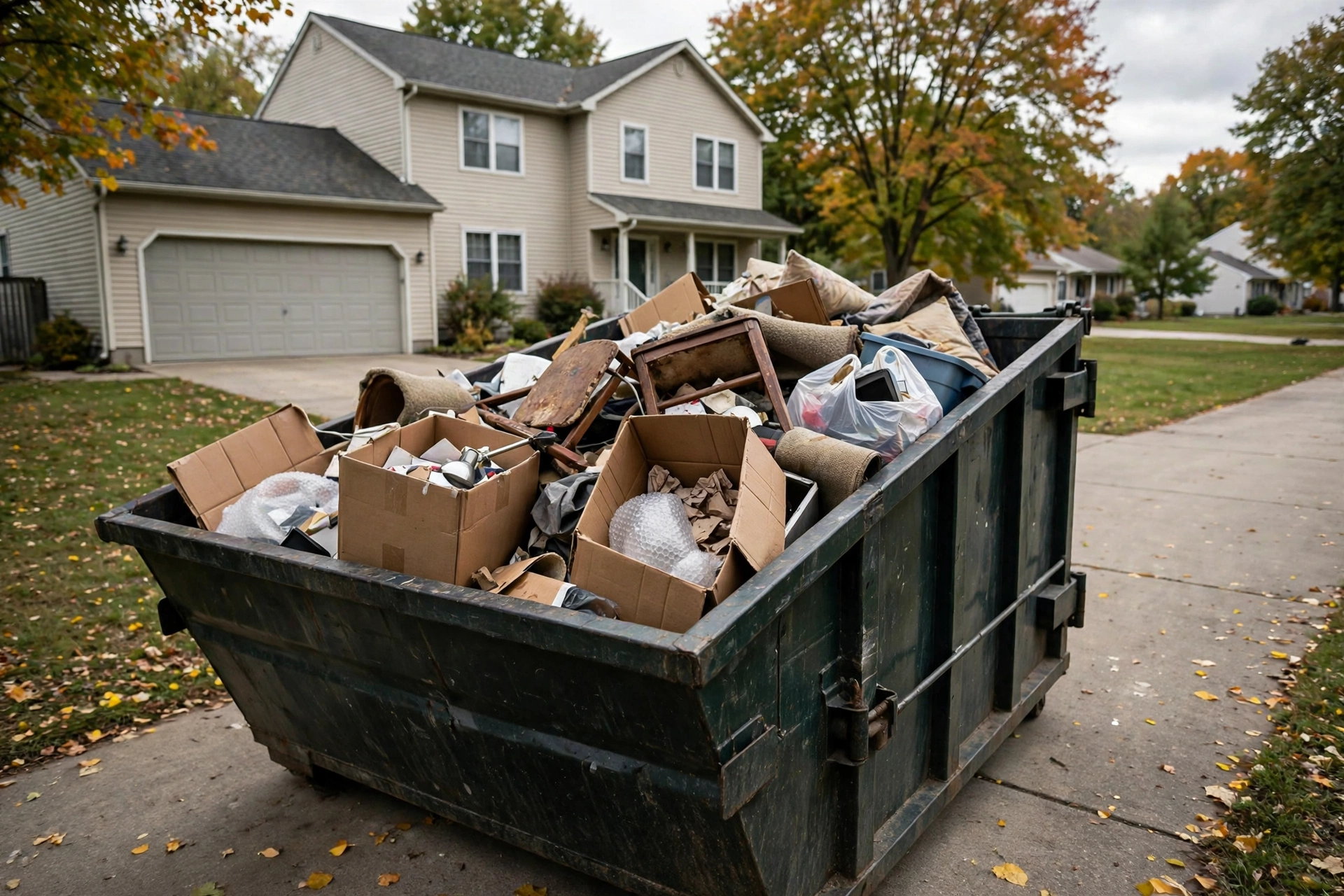
A 10-yard dumpster in Green Bay holds about 10 cubic yards, roughly three pickup truck loads, and it suits a small cleanout, a single room, or a small remodel. Yes, a standard couch fits, provided it sits below the fill line and the total load stays within the provider’s ton cap. Confirm size, tons, and price on the call.
What a 10-yard dumpster holds
A 10-yard dumpster holds about 10 cubic yards of debris, roughly 3 pickup truck loads. In practical terms, that is a small garage cleanout, a single room of furniture and boxes, a small bathroom remodel, a shed cleanout, or a small yard cleanup. It is the box for a job you can describe in one sentence, not a job that takes a week and fills every room in the house.
One published Green Bay size guide puts a 10-yard box at about 12 feet by 7 feet by 4 feet, with about 2 tons in its published terms, while the main competitor’s city-page range lists a 10-yard box at 1 ton. Dimensions and ton caps vary by provider, so treat those figures as a guide and confirm the provider’s actual box and cap on the call. The difference between 1 ton and 2 tons matters more than a foot of length when the load is heavy.
Load it in layers, heaviest at the bottom, and keep everything below the fill line. A box loaded above the fill line may not be hauled as-is. Break down furniture where you can, because flat pieces pack tighter than whole pieces standing on end, and that packing is often the difference between fitting in a 10-yard box and needing a swap.
Will a couch fit in a 10-yard dumpster?
Yes, a standard couch fits in a 10-yard dumpster, as long as it is placed so it does not stick above the fill line and the total load stays within the provider’s ton cap. A couch on its own is not a problem. A couch plus a room full of furniture, mattresses, and boxes is a different job, and that combination usually belongs in a 15-yard or 20-yard box, not a 10-yard one.
If the couch is the biggest item and the rest is a few bags and small pieces, a 10-yard box is a sensible choice. If you are also clearing a bedroom, a garage corner, and a basement pile, count the whole job before you book. Count in pickup loads: the couch is roughly one load on its own once it is broken down or laid flat, and the rest of the job adds up from there.
Tell the provider about the couch and the rest of the load on the call. Mattresses, upholstered furniture, and mixed household junk are normal contents for a small cleanout box, but the provider confirms what is accepted for your rental, and whether any item needs separate handling.
What a 10-yard box is right for
A 10-yard box is right for a small cleanout where the pile is already visible and contained. That includes a garage you can finally park in again, a single bedroom being cleared, a small bathroom torn out, a shed emptied, or a yard cleanup after a storm. It is also a good choice for a small remodel where the debris is mostly light: trim, drywall from one room, old flooring from one room, and the packaging that comes with it.
It works well on Green Bay driveways because it is the smallest roll-off box in common use here, and it fits more driveways than a 20-yard or 30-yard box. If your driveway is narrow, short, or shared, that fit is a real advantage. Measure the spot, check overhead wires, and tell the provider the exact placement. Providers typically need about 14 feet of overhead clearance.
It is also the cheapest starting point in most cases, because it is the smallest box. That only stays true if the load fits its volume and its ton cap. A small box that needs a second haul is no longer the cheap option, which is why the weight warning below matters more than the starting price.
What a 10-yard box is not right for
A 10-yard box is not right for a whole-house cleanout, a full kitchen remodel, a large roofing job, or a concrete load. If the job spans several rooms, or the debris includes a full roof tear-off, the volume alone will exceed 10 cubic yards, and you will pay for a swap or a second delivery that a larger box would have avoided.
It is also not the right box for a full load of heavy material. Concrete, dirt, brick, and asphalt will hit the ton cap before the box looks full. A 10-yard box can be used for a small amount of heavy material, but only with the provider’s ton cap and fill rules confirmed first. Ask whether the box must stay level with the fill line for heavy material, and whether clean concrete is priced differently from mixed debris. Do not load a heavy job and hope the weight works out.
If you are between a 10-yard and a 15-yard box, size up. The price difference between those two sizes is usually smaller than the cost of a second delivery, a swap, or an overweight fee, and a 15-yard box still fits most driveways that fit a 10-yard box.
The weight warning, in plain terms
A dumpster has two limits: volume in cubic yards, and weight in tons. Household junk usually fills by volume first. Heavy material fills by weight first. A 10-yard box of household junk and a 10-yard box of concrete are the same size and very different weights, and the provider’s ton cap is what decides whether the load is acceptable.
Published Green Bay terms show how much that cap varies. One published set lists a 10-yard box at about 2 tons, while the main competitor’s city-page range lists 1 ton. That gap is not a mistake to ignore; it is the reason you ask on the call. Ask: how many tons are included for a 10-yard box, what is the per-ton rate over that cap, and will you provide a scale ticket if I ask for one. Write the answers down before you agree.
Wet debris deserves the same caution. Leaves, branches, and storm debris weigh far more wet than dry, and a yard cleanup after rain can surprise you on weight even though the volume looks modest. If the load is wet or heavy, say so on the call.
How much does a 10-yard dumpster cost in Green Bay?
In competitor-published market ranges, checked Oct 2026, a 10-yard rental in Green Bay runs from about $300 in 7-day published terms to $480–$560 in the main competitor’s city-page range. Those are different rentals from different providers, with different days and tons included, so do not compare them as if they were the same product. The $300 figure comes with 7 days in its published set, while the main competitor’s base rental is 15 days. Confirm days, tons, and the per-ton overage rate on the call, and compare total cost, not headline price.
Extra days and overage are where a small rental can grow. One published Green Bay set notes extra days at $10/day, while the main competitor’s pricing page notes $21/day past the period and $89/ton over the cap, with a $150 trip fee. This page does not resolve that conflict, because the two figures come from different providers’ published terms. Ask which rates apply to your rental, and get the answer before delivery day.
An aggregator listing for Green Bay showed $378–$660 overall. Do not treat that as a hauler price for a 10-yard box, and do not quote it as one. Its own table notes “0 tons included” for some sizes, which conflicts with direct haulers.
Driveway, street, and seasonal fit
If the box goes on your driveway, you generally do not need a permit in Green Bay. If it goes on the street, sidewalk, alley, or other public right-of-way, you generally do need a permit from the municipality, and you may need barricades. The street permit fee and timeline for a dumpster in Green Bay are not verified, so this page does not publish them; confirm with City Public Works, or your village or town, before you schedule a street placement.
Do not place a loaded dumpster on a lawn without asking. The truck and box can rut and sink the lawn, especially when wet. In winter, clear snow and ice from the delivery spot before the truck arrives, and tell the provider if the driveway is steep or icy. Green Bay averages about 55.6 inches of snow a year, with a January mean high around 25.5°F, so winter placement is a planning point, not an afterthought. In spring, Wisconsin road weight limits, typically 6 tons single axle and 10 tons tandem from mid-March to mid-April, can affect heavy hauls and timing.
What cannot go in a 10-yard box
Wisconsin landfill bans cover electronics, major appliances, lead-acid batteries, waste oil and filters, tires, and paper and containers that belong in recycling. Yard waste has been banned from Wisconsin landfills since 1993, and tires since 1995. Hazardous chemicals, asbestos, liquid paint and solvents, motor oil, fluorescent lamps, medical waste, and flammable or explosive material do not belong in a rented dumpster either.
Appliances are provider-dependent in Green Bay. One local provider allows non-freon appliances, while the main competitor bans washers, dryers, and fridges. This page does not pick one rule as universal. Ask on the call before you load an appliance. A prohibited item can mean a rejected pickup, a return trip fee, or an extra disposal charge.
For small household junk that fits the city’s free limits, use the curb first. Bulk pickup weeks in 2026 were March 30–April 3 (rescheduled) and September 21–25, up to 2 cubic yards free, set out by 6 a.m. Overflow weeks were March 16–20, July 6–10, September 14–18, and December 28–January 2, up to four 32-gallon bags. Construction, remodeling, and demolition trash, appliances, electronics, and move-out debris are prohibited at the curb and at the East/West drop-offs (1820 Mills St and 519 S Oneida St), and are charged to the property owner if left out.
Internal links
- Green Bay dumpster rental guide — the pillar guide for sizes, costs, permits, and disposal in one place.
- How to choose the right size for your job
- What a dumpster costs in Green Bay, with days and tons
- The middle box for remodels and roofs
- The versatile box for bigger home jobs
Call now — have these five facts ready
Call (920) 274-9992
- Size or job — the size you think you need, or a plain description of the job.
- Material — household junk, remodel debris, roofing shingles, concrete, yard waste, or mixed.
- Address / ZIP — Green Bay, De Pere, Howard, Ashwaubenon, Bellevue, Allouez, or Suamico.
- Date and days — when you need it, and how many days you need it.
- Placement — driveway, or street / alley / lawn.
Disclosure
This website connects callers to independent local dumpster providers through a call network. It is not the hauler, owns no trucks or dumpsters, sets no price, and guarantees nothing. The provider on the call confirms your size, price, days, tons, overage rate, delivery window, pickup process, and whether a street permit is needed for your address. If a provider’s answer differs from a guide on this page, the provider’s answer for your specific job controls.